Gallery software is software that helps the user publish or share photos, pictures, videos or other digital media. Most galleries are located on Web servers, where users are allowed to register and publish their pictures. Gallery software usually features automatic image resizing, allows digital media be categorized into sets, and allows comments. == Types == Early digital media publishing and sharing was done with imageboards. The boards are by topics, sometimes called "chan". Each discussion in a "chan" are started with a piece of digital media, and follow-up discussions can contain another piece too. Software works in this way: Futallaby, Danbooru. Traditionally, galleries are managed. An administrator maintains a set of or hierarchy of albums. The users can upload their digital media in one of the existing albums defined by an administrator, or create their own albums. The users with sufficient permission can re-categorise the digital media others uploaded. Often, the site's administrator can define which album the users are allowed to categorise their media into, or delete other user's content. Examples are open source galleries Coppermine, Gallery Project. There are decentralised gallery software that does not have an administrator for managing contents. Pinterest, Flickr and DeviantArt has been successful with this model. Open source gallery software MediaGoblin works in this way. Each user can create their own "collections", to categorise theirs or other users' media. However users cannot put media into other user's collections. Each user's category is separate. There is no centralised theme or hierarchy for the media.
Gibberlink
GibberLink is an acoustic data transmission project, with an open-source client available on GitHub, in which two conversational AI agents switch from speaking to one another in a Human-listenable language (such as English) to their own unique language that consists of a sound-level protocol after confirming they are both AI agents. The project was created by Anton Pidkuiko and Boris Starkov. == Reception == The project won the global top prize at the ElevenLabs Worldwide Hackathon. It has also been cited as raising questions around AI ethics and oversight. On February 23, 2025, a YouTube video of two independent conversational ElevenLabs AI agents being prompted to chat about booking a hotel (one as a caller, one as a receptionist) received coverage for going viral. In this video, both agents are prompted to switch to ggwave data-over-sound protocol when they identify the other side as AI, and keep speaking in English otherwise.
Find It, Fix It
Find It, Fix It is a mobile app developed by the city of Seattle to report non-emergency issues. == History == The City of Seattle launched Find It, Fix It in 2013 for Android and iOS phones to let citizens report potholes, graffiti, and other problems they observe to the city. The app did not support Windows Phone, making it inaccessible to Microsoft employees in the city who used the company's then-supported mobile operating system. In 2015, Mayor Ed Murray led a Find It, Fix It walk with about 100 other people, including police officers, in the University District. Participants were encouraged to use the app to report problems they observed in the neighborhood. Later Find It, Fix It walks have taken place in neighborhoods including Crown Hill, First Hill, Belltown, Wallingford, and Highland Park. In 2020, Find It, Fix It added support for reporting issues with the dockless bicycle sharing systems in the city. Citing the success of Seattle’s app, the nearby city of Kent, Washington, announced that it would create a similar customer service app. == Usage == Users of Find It, Fix It can submit reports about graffiti, potholes, parking violations, broken street signs, and other issues. The app is designed to use a smartphone’s camera and GPS features to make it easier for users to file reports. The Atlantic reported in 2018 that Find It, Fix It was being used by neighborhood groups to report homeless encampments with the intention of having authorities remove them, citing examples of campaigns in Ravenna and Ballard. The executive director of Ballard Alliance, a local chamber of commerce for businesses in the neighborhood, used a private Facebook group to encourage business owners to use the app to report homeless encampments. In response to a poster campaign in the summer of 2019 with the slogan “See a tent? Report a tent”, a representative for the mayor’s office and two Seattle City Council members said that it was inappropriate to encourage use of Find It, Fix It to displace homeless people. As a backlash to these campaigns, people living far from Seattle filed hoax complaints using the app, such as by using photos of tents on display at REI stores. According to the Seattle Times, between January 1, 2020, and November 15, 2021, the city had received over 230,000 service requests, of which 77% were submitted via Find It, Fix It. The largest category of these, numbering over 55,000, concerned illegal dumping. Of complaints categorized as "parking", 3,000 had comments explicitly mentioning issues around homelessness. The ZIP code 98134, covering an industrial area south of Pioneer Square and north of Georgetown, had 5,559 service requests per 1,000 residents, by far the highest in the city.
Softwarp
Softwarp is a software technique to warp an image so that it can be projected on a curved screen. This can be done in real time by inserting the softwarp as a last step in the rendering cycle. The problem is to know how the image should be warped to look correct on the curved screen. There are several techniques to auto calibrate the warping by projecting a pattern and using cameras and/or sensors. The information from the sensors is sent to the software so that it can analyze the data and calculate the curvature of the projection screen. == Usage == The softwarp can be used to project virtual views on curved walls and domes. These are usually used in vehicle simulators, for instance boat-, car- and airplane simulators. To make it possible to cover a dome with a 360 degree view you need to use several projectors. A problem with using several projectors on the same screen is that the edges between the projected images get about twice the amount of light. This is solved by using a technique called edge blending. With this technique a “filter” is inserted on the edge that fades the image from 100% light strength (luminance) to 0% (the lowest luminance depends on the contrast ratio of the projector). == History == The first warping technologies used a hardware image processing unit to warp the image. This processing unit was inserted between the graphics card and the projector. The problem with this technique is that it depends on the type of signal and the quality of the signal from the graphics card to warp it correctly. The process unit also needs several lines of image information before it can start sending out the warped image. This adds a latency to the display system that could be a problem in simulators that need fast response time, for instance fighter jet simulators. Softwarping eliminates the latency.
Drops (app)
Drops is a language learning app that was created in Estonia by Daniel Farkas and Mark Szulyovszky in 2015. It is the second product from the company, after their first app, LearnInvisible, had issues in retaining a user's engagement over the required time period. The languages available include Native Hawaiian and Māori, and was classified as one of the fifty "Most Innovative Companies" for 2019 by Fast Company. The company partnered with Global Eagle Entertainment to include Travel Talk, a feature intended to focus on words and phrases frequently used by travelers. At the beginning of the COVID-19 pandemic in March 2020, the number of users increased by 55 percent in the United States and 92 percent in the United Kingdom. Droplets, a language app for children, includes profiles for multiple teachers working with remote students. The company also produces an app called Scripts, intended to help users learn to write alphabets. The app was purchased by the Norwegian company Kahoot! on 24 November 2020.
Layers (digital image editing)
Layers are used in digital image editing to separate different elements of an image. A layer can be compared to a transparency on which imaging effects or images are applied and placed over or under an image. Today they are an integral feature of image editors. In the early days of computing, memory was at a premium and the idea of using multi-layered images was considered infeasible in personal computer applications as the tradeoffs were image size and color depth. As the price of memory fell it became feasible to apply the concept of layering to raster images. The first software known to apply the concept of layers was LALF, which was released in 1989 for the NEC PC-9801. LALF's terminology for layers is "cells", after the concept of drawing animation frames over-top of a stencil. Layers were introduced in Western markets by Fauve Matisse (later Macromedia xRes), and then available in Adobe Photoshop 3.0, in 1994, which lead to widespread adoption. In vector image editors that support animation, layers are used to further enable manipulation along a common timeline for the animation; in SVG images, the equivalent to layers are "groups". == Layer types == There are different kinds of layers, and not all of them exist in all programs. They represent a part of a picture, either as pixels or as modification instructions. They are stacked on top of each other, and depending on the order, determine the appearance of the final picture. In graphics software, layers are the different levels at which one can place an object or image file. In the program, layers can be stacked, merged, or defined when creating a digital image. Layers can be partially obscured allowing portions of images within a layer to be hidden or shown in a translucent manner within another image. Layers can also be used to combine two or more images into a single digital image. For the purpose of editing, working with layers allows for applying changes to just one specific layer. == Layer (basic) == The standard layer available to most programs consists of a rectangular, semitransparent picture which may be superimposed over other layers. Some programs require that layers cover the same area as the final canvas, but others offer layers of multiple sizes. Each layer may bear individual settings, such as opacity, blending modes, dynamic filters, and potentially hundreds of other properties. == Layer mask == A layer mask is linked to a layer and hides part of the layer from the picture. What is painted black on the layer mask will not be visible in the final picture. What is grey will be more or less transparent depending on the shade of grey. As the layer mask can be both edited and moved around independently of both the background layer and the layer it applies to, it gives the user the ability to test a lot of different combinations of overlay. == Adjustment layer == An adjustment layer typically applies a common effect like brightness or saturation to other layers. However, as the effect is stored in a separate layer, it is easy to try it out and switch between different alternatives, without changing the original layer. In addition, an adjustment layer can easily be edited, just like a layer mask, so an effect can be applied to just part of the image.
Anthrobotics
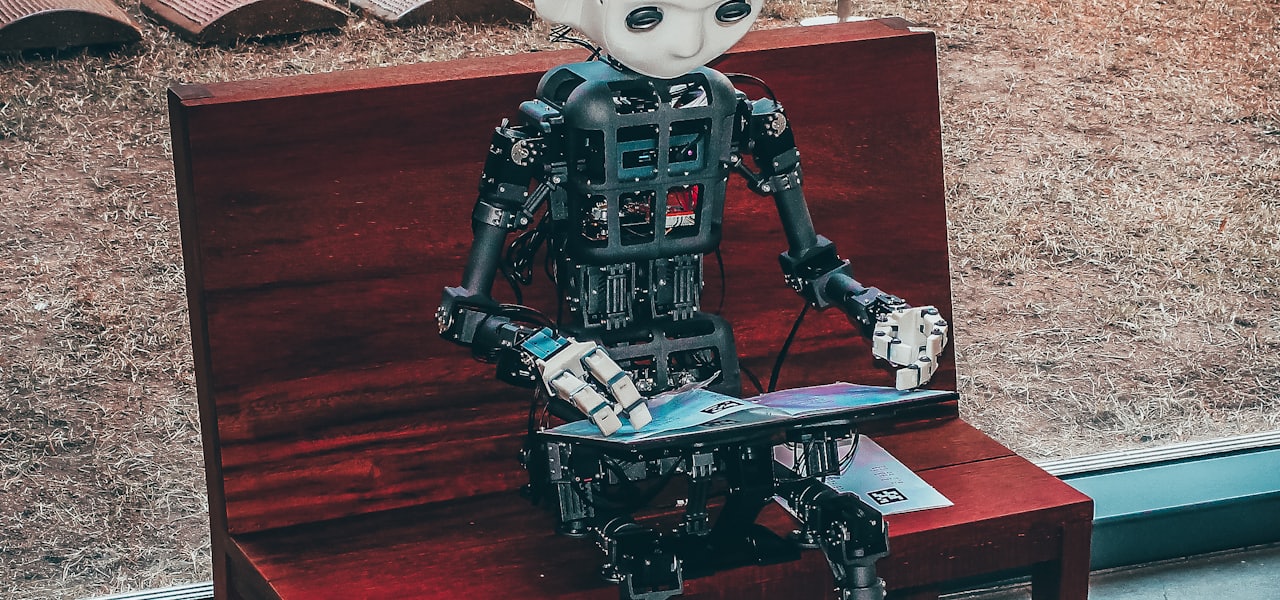
Anthrobotics is the science of developing and studying robots that are either entirely or in some way human-like. The term anthrobotics was originally coined by Mark Rosheim in a paper entitled "Design of An Omnidirectional Arm" presented at the IEEE International Conference on Robotics and Automation, May 13–18, 1990, pp. 2162–2167. Rosheim says he derived the term from "...Anthropomorphic and Robotics to distinguish the new generation of dexterous robots from its simple industrial robot forebears." The word gained wider recognition as a result of its use in the title of Rosheim's subsequent book Robot Evolution: The Development of Anthrobotics, which focussed on facsimiles of human physical and psychological skills and attributes. However, a wider definition of the term anthrobotics has been proposed, in which the meaning is derived from anthropology rather than anthropomorphic. This usage includes robots that respond to input in a human-like fashion, rather than simply mimicking human actions, thus theoretically being able to respond more flexibly or to adapt to unforeseen circumstances. This expanded definition also encompasses robots that are situated in social environments with the ability to respond to those environments appropriately, such as insect robots, robotic pets, and the like. Anthrobotics is now taught at some universities, encouraging students not only to design and build robots for environments beyond current industrial applications, but also to speculate on the future of robotics that are embedded in the world at large, as mobile phones and computers are today. In 2016 philosopher Luis de Miranda created the Anthrobotics Cluster at the University of Edinburgh "a platform of cross-disciplinary research that seeks to investigate some of the biggest questions that will need to be answered" on the relationship between humans, robots and intelligent systems and "a think tank on the social spread of robotics, and also how automation is part of the definition of what humans have always been". to explore the symbiotic relationship between humans and automated protocols.