AI Chatbots and Assistants

Explore the best AI Chatbots and Assistants — independent reviews, comparisons, pricing and step-by-step how-to guides, curated by Aizhi.

  • Socially assistive robot

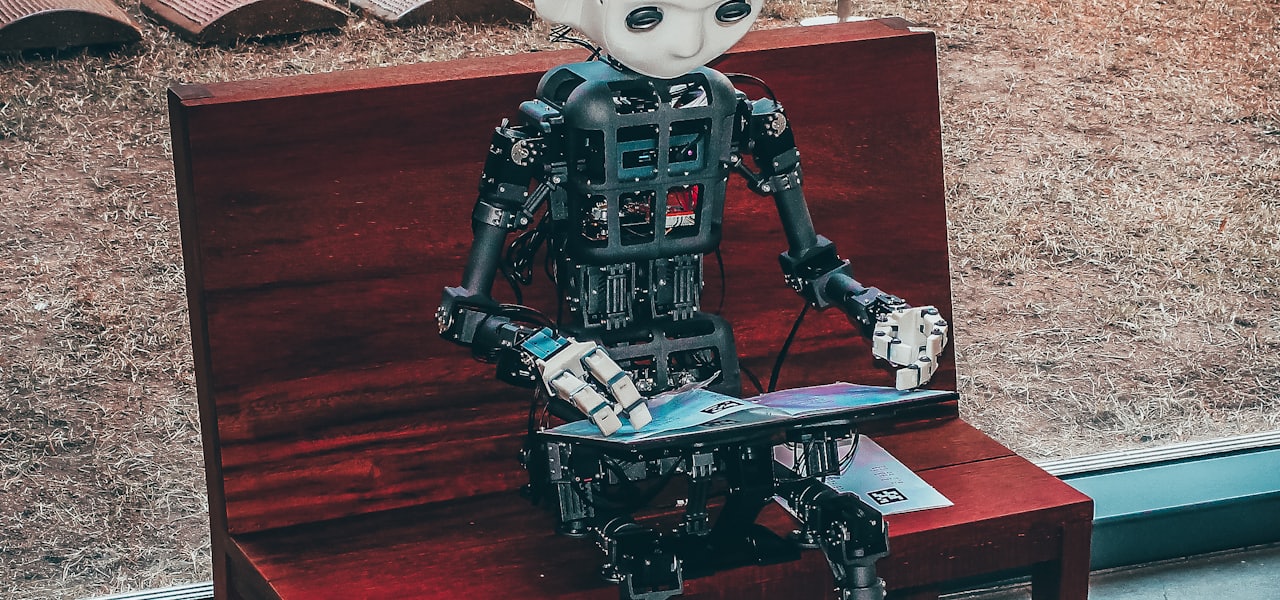
    Socially assistive robot

    A socially assistive robot (SAR) aids users through social engagement and support rather than through physical tasks and interactions. == Background == The field of socially assistive robotics emerged in the early 2000s, following the emergence of the field of social robots. In contrast to social robots, SARs aid users with specific goals related to behavior change rather than serving as purely social entities. The term "Socially assistive robot" was initially defined by Maja Matarić and David Feil-Seifer in 2005. Since its inception, the field has gained substantial recognition, featuring numerous research projects, a wealth of global research publications, startup companies, and a growing array of products on the consumer market. The COVID-19 pandemic has underscored the immense potential of socially assistive robots, particularly in addressing the needs of large user populations, including children engaged in remote learning, elderly individuals grappling with loneliness, and those affected by social isolation and its associated negative consequences. == Characteristics of interaction == SARs rely on artificial intelligence (AI) to generate real-time, responsive, natural, and meaningful robot behaviors during interactions with humans. The robots employ various forms of communication, such as facial expressions, gestures, body movements, and speech. In contrast to robots intended for physical tasks, SARs are designed to support and motivate users to perform their own tasks. The tasks a user engages in can be physical (e.g., rehabilitation exercises for post-stroke users), cognitive (e.g., dementia screening for elderly users), or social (e.g., turn-taking for users with autism spectrum disorders). This complex interaction involves detecting and interpreting the user's movement, behavior, intent, goals, speech, and preferences. Machine learning and robot learning techniques are frequently employed to enhance the robot's understanding of the user, predict user preferences, and provide effective assistance. The effectiveness of socially assistive robots is assessed based on objective measurements of user performance and improvement resulting from the robot’s assistance and support. Unlike other branches of robotics, where effectiveness depends on the robot's physical task completion, SAR measures the success of the robot based on the user's progress and achievements. This evaluation is carried out using quantitative objective metrics, such as time spent on tasks, accuracy, retention, and verbalization, as well as quantitative subjective metrics, such as user survey tools. SAR is based on the large body of evidence showing that users tend to respond more positively to interactions with physical robots compared to interactions with screens. Interaction with physical robots also encourages users to learn and retain more information than screen-based interactions. This fundamental insight underlines why physical robots in SAR applications are more effective, as opposed to interactions solely involving screens, tablets, or computers. == Uses and applications == SARs have been developed and validated in a wide array of applications, including healthcare, elder care, education, and training. For example, SARs have been developed to support children on the autism spectrum in acquiring and practicing social and cognitive skills, to motivate and coach stroke patients throughout their rehabilitation exercises, monitoring individuals health (ex. fall detection), and to encourage elderly users to be more physically and socially active. There is a concern that technophobia and lack of trust in robots will pose a barrier to the effectiveness of SARs in older adults.

    Read more →
  • Feature selection

    Feature selection

    In machine learning, feature selection is the process of selecting a subset of relevant features (variables, predictors) for use in model construction. Feature selection techniques are used for several reasons: simplification of models to make them easier to interpret, shorter training times, to avoid the curse of dimensionality, improve the compatibility of the data with a certain learning model class, to encode inherent symmetries present in the input space. The central premise when using feature selection is that data sometimes contains features that are redundant or irrelevant, and can thus be removed without incurring much loss of information. Redundancy and irrelevance are two distinct notions, since one relevant feature may be redundant in the presence of another relevant feature with which it is strongly correlated. Feature extraction creates new features from functions of the original features, whereas feature selection finds a subset of the features. Feature selection techniques are often used in domains where there are many features and comparatively few samples (data points). == Introduction == A feature selection algorithm can be seen as the combination of a search technique for proposing new feature subsets, along with an evaluation measure which scores the different feature subsets. The simplest algorithm is to test each possible subset of features finding the one which minimizes the error rate. This is an exhaustive search of the space, and is computationally intractable for all but the smallest of feature sets. The choice of evaluation metric heavily influences the algorithm, and it is these evaluation metrics which distinguish between the three main categories of feature selection algorithms: wrappers, filters and embedded methods. Wrapper methods use a predictive model to score feature subsets. Each new subset is used to train a model, which is tested on a hold-out set. Counting the number of mistakes made on that hold-out set (the error rate of the model) gives the score for that subset. As wrapper methods train a new model for each subset, they are very computationally intensive, but usually provide the best performing feature set for that particular type of model or typical problem. Filter methods use a proxy measure instead of the error rate to score a feature subset. This measure is chosen to be fast to compute, while still capturing the usefulness of the feature set. Common measures include the mutual information, the pointwise mutual information, Pearson product-moment correlation coefficient, Relief-based algorithms, and inter/intra class distance or the scores of significance tests for each class/feature combinations. Filters are usually less computationally intensive than wrappers, but they produce a feature set which is not tuned to a specific type of predictive model. This lack of tuning means a feature set from a filter is more general than the set from a wrapper, usually giving lower prediction performance than a wrapper. However the feature set doesn't contain the assumptions of a prediction model, and so is more useful for exposing the relationships between the features. Many filters provide a feature ranking rather than an explicit best feature subset, and the cut off point in the ranking is chosen via cross-validation. Filter methods have also been used as a preprocessing step for wrapper methods, allowing a wrapper to be used on larger problems. One other popular approach is the Recursive Feature Elimination algorithm, commonly used with Support Vector Machines to repeatedly construct a model and remove features with low weights. Embedded methods are a catch-all group of techniques which perform feature selection as part of the model construction process. The exemplar of this approach is the LASSO method for constructing a linear model, which penalizes the regression coefficients with an L1 penalty, shrinking many of them to zero. Any features which have non-zero regression coefficients are 'selected' by the LASSO algorithm. Improvements to the LASSO include Bolasso which bootstraps samples; Elastic net regularization, which combines the L1 penalty of LASSO with the L2 penalty of ridge regression; and FeaLect which scores all the features based on combinatorial analysis of regression coefficients. AEFS further extends LASSO to nonlinear scenario with autoencoders. These approaches tend to be between filters and wrappers in terms of computational complexity. In traditional regression analysis, the most popular form of feature selection is stepwise regression, which is a wrapper technique. It is a greedy algorithm that adds the best feature (or deletes the worst feature) at each round. The main control issue is deciding when to stop the algorithm. In machine learning, this is typically done by cross-validation. In statistics, some criteria are optimized. This leads to the inherent problem of nesting. More robust methods have been explored, such as branch and bound and piecewise linear network. == Subset selection == Subset selection evaluates a subset of features as a group for suitability. Subset selection algorithms can be broken up into wrappers, filters, and embedded methods. Wrappers use a search algorithm to search through the space of possible features and evaluate each subset by running a model on the subset. Wrappers can be computationally expensive and have a risk of over fitting to the model. Filters are similar to wrappers in the search approach, but instead of evaluating against a model, a simpler filter is evaluated. Embedded techniques are embedded in, and specific to, a model. Many popular search approaches use greedy hill climbing, which iteratively evaluates a candidate subset of features, then modifies the subset and evaluates if the new subset is an improvement over the old. Evaluation of the subsets requires a scoring metric that grades a subset of features. Exhaustive search is generally impractical, so at some implementor (or operator) defined stopping point, the subset of features with the highest score discovered up to that point is selected as the satisfactory feature subset. The stopping criterion varies by algorithm; possible criteria include: a subset score exceeds a threshold, a program's maximum allowed run time has been surpassed, etc. Alternative search-based techniques are based on targeted projection pursuit which finds low-dimensional projections of the data that score highly: the features that have the largest projections in the lower-dimensional space are then selected. Search approaches include: Exhaustive Best first Simulated annealing Genetic algorithm Greedy forward selection Greedy backward elimination Particle swarm optimization Targeted projection pursuit Scatter search Variable neighborhood search Two popular filter metrics for classification problems are correlation and mutual information, although neither are true metrics or 'distance measures' in the mathematical sense, since they fail to obey the triangle inequality and thus do not compute any actual 'distance' – they should rather be regarded as 'scores'. These scores are computed between a candidate feature (or set of features) and the desired output category. There are, however, true metrics that are a simple function of the mutual information; see here. Other available filter metrics include: Class separability Error probability Inter-class distance Probabilistic distance Entropy Consistency-based feature selection Correlation-based feature selection == Optimality criteria == The choice of optimality criteria is difficult as there are multiple objectives in a feature selection task. Many common criteria incorporate a measure of accuracy, penalised by the number of features selected. Examples include Akaike information criterion (AIC) and Mallows's Cp, which have a penalty of 2 for each added feature. AIC is based on information theory, and is effectively derived via the maximum entropy principle. Other criteria are Bayesian information criterion (BIC), which uses a penalty of log ⁡ n {\displaystyle {\sqrt {\log {n}}}} for each added feature, minimum description length (MDL) which asymptotically uses log ⁡ n {\displaystyle {\sqrt {\log {n}}}} , Bonferroni / RIC which use 2 log ⁡ p {\displaystyle {\sqrt {2\log {p}}}} , maximum dependency feature selection, and a variety of new criteria that are motivated by false discovery rate (FDR), which use something close to 2 log ⁡ p q {\displaystyle {\sqrt {2\log {\frac {p}{q}}}}} . A maximum entropy rate criterion may also be used to select the most relevant subset of features. == Structure learning == Filter feature selection is a specific case of a more general paradigm called structure learning. Feature selection finds the relevant feature set for a specific target variable whereas structure learning finds the relationships between all the variables, usually by expressing these relationships as a graph. The most common structure learning algorithms

    Read more →
  • Neural cryptography

    Neural cryptography

    Neural cryptography is a branch of cryptography dedicated to analyzing the application of stochastic algorithms, especially artificial neural network algorithms, for use in encryption and cryptanalysis. == Definition == Artificial neural networks are well known for their ability to selectively explore the solution space of a given problem. This feature finds a natural niche of application in the field of cryptanalysis. At the same time, neural networks offer a new approach to attack ciphering algorithms based on the principle that any function could be reproduced by a neural network, which is a powerful proven computational tool that can be used to find the inverse-function of any cryptographic algorithm. The ideas of mutual learning, self learning, and stochastic behavior of neural networks and similar algorithms can be used for different aspects of cryptography, like public-key cryptography, solving the key distribution problem using neural network mutual synchronization, hashing or generation of pseudo-random numbers. Another idea is the ability of a neural network to separate space in non-linear pieces using "bias". It gives different probabilities of activating the neural network or not. This is very useful in the case of Cryptanalysis. Two names are used to design the same domain of research: Neuro-Cryptography and Neural Cryptography. The first work that it is known on this topic can be traced back to 1995 in an IT Master Thesis. == Applications == In 1995, Sebastien Dourlens applied neural networks to cryptanalyze DES by allowing the networks to learn how to invert the S-tables of the DES. The bias in DES studied through Differential Cryptanalysis by Adi Shamir is highlighted. The experiment shows about 50% of the key bits can be found, allowing the complete key to be found in a short time. Hardware application with multi micro-controllers have been proposed due to the easy implementation of multilayer neural networks in hardware. One example of a public-key protocol is given by Khalil Shihab . He describes the decryption scheme and the public key creation that are based on a backpropagation neural network. The encryption scheme and the private key creation process are based on Boolean algebra. This technique has the advantage of small time and memory complexities. A disadvantage is the property of backpropagation algorithms: because of huge training sets, the learning phase of a neural network is very long. Therefore, the use of this protocol is only theoretical so far. == Neural key exchange protocol == The most used protocol for key exchange between two parties A and B in the practice is Diffie–Hellman key exchange protocol. Neural key exchange, which is based on the synchronization of two tree parity machines, should be a secure replacement for this method. Synchronizing these two machines is similar to synchronizing two chaotic oscillators in chaos communications. === Tree parity machine === The tree parity machine is a special type of multi-layer feedforward neural network. It consists of one output neuron, K hidden neurons and K×N input neurons. Inputs to the network take three values: x i j ∈ { − 1 , 0 , + 1 } {\displaystyle x_{ij}\in \left\{-1,0,+1\right\}} The weights between input and hidden neurons take the values: w i j ∈ { − L , . . . , 0 , . . . , + L } {\displaystyle w_{ij}\in \left\{-L,...,0,...,+L\right\}} Output value of each hidden neuron is calculated as a sum of all multiplications of input neurons and these weights: σ i = sgn ⁡ ( ∑ j = 1 N w i j x i j ) {\displaystyle \sigma _{i}=\operatorname {sgn}(\sum _{j=1}^{N}w_{ij}x_{ij})} Signum is a simple function, which returns −1,0 or 1: sgn ⁡ ( x ) = { − 1 if x < 0 , 0 if x = 0 , 1 if x > 0. {\displaystyle \operatorname {sgn}(x)={\begin{cases}-1&{\text{if }}x<0,\\0&{\text{if }}x=0,\\1&{\text{if }}x>0.\end{cases}}} If the scalar product is 0, the output of the hidden neuron is mapped to −1 in order to ensure a binary output value. The output of neural network is then computed as the multiplication of all values produced by hidden elements: τ = ∏ i = 1 K σ i {\displaystyle \tau =\prod _{i=1}^{K}\sigma _{i}} Output of the tree parity machine is binary. === Protocol === Each party (A and B) uses its own tree parity machine. Synchronization of the tree parity machines is achieved in these steps Initialize random weight values Execute these steps until the full synchronization is achieved Generate random input vector X Compute the values of the hidden neurons Compute the value of the output neuron Compare the values of both tree parity machines Outputs are the same: one of the suitable learning rules is applied to the weights Outputs are different: go to 2.1 After the full synchronization is achieved (the weights wij of both tree parity machines are same), A and B can use their weights as keys. This method is known as a bidirectional learning. One of the following learning rules can be used for the synchronization: Hebbian learning rule: w i + = g ( w i + σ i x i Θ ( σ i τ ) Θ ( τ A τ B ) ) {\displaystyle w_{i}^{+}=g(w_{i}+\sigma _{i}x_{i}\Theta (\sigma _{i}\tau )\Theta (\tau ^{A}\tau ^{B}))} Anti-Hebbian learning rule: w i + = g ( w i − σ i x i Θ ( σ i τ ) Θ ( τ A τ B ) ) {\displaystyle w_{i}^{+}=g(w_{i}-\sigma _{i}x_{i}\Theta (\sigma _{i}\tau )\Theta (\tau ^{A}\tau ^{B}))} Random walk: w i + = g ( w i + x i Θ ( σ i τ ) Θ ( τ A τ B ) ) {\displaystyle w_{i}^{+}=g(w_{i}+x_{i}\Theta (\sigma _{i}\tau )\Theta (\tau ^{A}\tau ^{B}))} Where: Θ ( a , b ) = 0 {\displaystyle \Theta (a,b)=0} if a ≠ b {\displaystyle a\neq b} otherwise Θ ( a , b ) = 1 {\displaystyle \Theta (a,b)=1} And: g ( x ) {\displaystyle g(x)} is a function that keeps the w i {\displaystyle w_{i}} in the range { − L , − L + 1 , . . . , 0 , . . . , L − 1 , L } {\displaystyle \{-L,-L+1,...,0,...,L-1,L\}} === Attacks and security of this protocol === In every attack it is considered, that the attacker E can eavesdrop messages between the parties A and B, but does not have an opportunity to change them. ==== Brute force ==== To provide a brute force attack, an attacker has to test all possible keys (all possible values of weights wij). By K hidden neurons, K×N input neurons and boundary of weights L, this gives (2L+1)KN possibilities. For example, the configuration K = 3, L = 3 and N = 100 gives us 310253 key possibilities, making the attack impossible with today's computer power. ==== Learning with own tree parity machine ==== One of the basic attacks can be provided by an attacker, who owns the same tree parity machine as the parties A and B. He wants to synchronize his tree parity machine with these two parties. In each step there are three situations possible: Output(A) ≠ Output(B): None of the parties updates its weights. Output(A) = Output(B) = Output(E): All the three parties update weights in their tree parity machines. Output(A) = Output(B) ≠ Output(E): Parties A and B update their tree parity machines, but the attacker can not do that. Because of this situation his learning is slower than the synchronization of parties A and B. It has been proven, that the synchronization of two parties is faster than learning of an attacker. It can be improved by increasing of the synaptic depth L of the neural network. That gives this protocol enough security and an attacker can find out the key only with small probability. ==== Other attacks ==== For conventional cryptographic systems, we can improve the security of the protocol by increasing of the key length. In the case of neural cryptography, we improve it by increasing of the synaptic depth L of the neural networks. Changing this parameter increases the cost of a successful attack exponentially, while the effort for the users grows polynomially. Therefore, breaking the security of neural key exchange belongs to the complexity class NP. Alexander Klimov, Anton Mityaguine, and Adi Shamir say that the original neural synchronization scheme can be broken by at least three different attacks—geometric, probabilistic analysis, and using genetic algorithms. Even though this particular implementation is insecure, the ideas behind chaotic synchronization could potentially lead to a secure implementation. === Permutation parity machine === The permutation parity machine is a binary variant of the tree parity machine. It consists of one input layer, one hidden layer and one output layer. The number of neurons in the output layer depends on the number of hidden units K. Each hidden neuron has N binary input neurons: x i j ∈ { 0 , 1 } {\displaystyle x_{ij}\in \left\{0,1\right\}} The weights between input and hidden neurons are also binary: w i j ∈ { 0 , 1 } {\displaystyle w_{ij}\in \left\{0,1\right\}} Output value of each hidden neuron is calculated as a sum of all exclusive disjunctions (exclusive or) of input neurons and these weights: σ i = θ N ( ∑ j = 1 N w i j ⊕ x i j ) {\displaystyle \sigma _{i}=\theta _{N}(\sum _{j=1}^{N}w_{ij}\oplus x_{ij})} (⊕ means XOR). Th

    Read more →
  • Common Voice

    Common Voice

    Common Voice is a crowdsourcing project started by Mozilla to create a free and open speech corpus. The project is supported by volunteers who record sample sentences with a microphone and review recordings of other users. The transcribed sentences are collected in a voice database available under the public domain license CC0. This license ensures that developers can use the database for voice-to-text and text-to-voice applications without restrictions or costs. == Aims == Common Voice aims to provide diverse voice samples. According to Mozilla's Katharina Borchert, many existing projects took datasets from public radio or otherwise had datasets that underrepresented both women and people with pronounced accents. == Voice database == The first dataset was released in November 2017. More than 20,000 users worldwide had recorded 500 hours of English sentences. In February 2019, the first batch of languages was released for use. This included 18 languages such as English, French, German and Mandarin Chinese, but also less prevalent languages like Welsh and Kabyle. In total, this included almost 1,400 hours of recorded voice data from more than 42,000 contributors. By July 2020 the database had amassed 7,226 hours of voice recordings in 54 languages, 5,591 hours of which had been verified by volunteers. In May 2021, following the work to add Kinyarwanda, the project received a grant to add Kiswahili. At the beginning of 2022, Bengali.AI partnered with Common Voice to launch the "Bangla Speech Recognition" project that aims to make machines understand the Bangla language. 2000 hours of voice was collected. In September 2022, it was announced that the Twi language of Ghana was the 100th language to be added to the database. As of December 2025, Mozilla Common Voice collects voice data for over 250 languages, with the most hours having been collected in English, Catalan, Kinyarwanda, Belarusian and Esperanto.

    Read more →
  • Teamwork (project management)

    Teamwork (project management)

    Teamwork.com is an Irish, privately owned, web-based software company headquartered in Cork, Ireland. Teamwork creates task management and team collaboration software. Founded in 2007, as of 2016 the company stated that its software was in use by over 370,000 organisations worldwide (including Disney, Spotify and HP), and that it had over 2.4m users. == History == Peter Coppinger and Dan Mackey founded a company, Digital Crew, in 2007. This company built websites, intranets and custom web-based solutions for clients in Cork, Ireland. Frustrated by whiteboards and software management tools, Coppinger wanted a software system that would help manage client projects and which would be easy to use and generic enough to be used by different types of companies. Originally 37signals Basecamp users themselves, Coppinger and Mackey were frustrated by the limited feature set, and by Basecamp's apparent inaction on their feedback. In October 2007, Coppinger and Mackey launched Teamwork Project Manager, nicknamed TeamworkPM. In March 2015, this was renamed as Teamwork Projects. In 2014, after two years of negotiations, TeamworkPM bought the domain name 'Teamwork.com' for US$675,000 (€500,000). At the time this was one of the most expensive domain name purchases by an Irish company, and involved the transfer of a domain name which had been dormant since it was first acquired by the original owner in 1999. In 2015, Teamwork.com was named by Gartner to be one of their "Cool Vendors" in the Program and Portfolio Management Category. This was followed by the launch of a new real-time messaging product, Teamwork Chat, in January 2015. In June 2015, the company announced a drive to recruit for 40 positions by the end of the year. This was followed by the announcement that the company was investing more than €1 million in a new office, and had leased office space in Park House, Blackpool. In June 2016, Teamwork.com undertook a further recruitment drive to entice developers to Cork. In July 2021, the company announced that it had raised an investment of $70 million (€59.1 million) from venture capital firm Bregal Milestone to fund further growth. == Products == Teamwork markets a number of cloud-based applications, including Teamwork, Teamwork Desk, Teamwork Spaces, Teamwork CRM and Teamwork Chat. Teamwork was launched on 4 October 2007, at which time it had time management, milestone management, file sharing, time tracking, and messaging features. Teamwork's platform reportedly integrates with martech software like HubSpot, as well as other productivity tools like Slack, G Suite, MS Teams, Zapier, Dropbox and QuickBooks. == Awards == In 2016, Teamwork was awarded Cork's Best SME in the Cork Chamber of Commerce "Company of the Year" awards. In 2016, Teamwork was named number 7 in Deloitte's Fast 50 tech companies hit €1.6bn turnover. In 2015, Teamwork was identified as a Gartner "Cool Vendor" in the Program and Portfolio Management Category.

    Read more →
  • Tucker decomposition

    Tucker decomposition

    In mathematics, Tucker decomposition decomposes a tensor into a set of matrices and one small core tensor. It is named after Ledyard R. Tucker although it goes back to Hitchcock in 1927. Initially described as a three-mode extension of factor analysis and principal component analysis it may actually be generalized to higher mode analysis, which is also called higher-order singular value decomposition (HOSVD) or the M-mode SVD. The algorithm to which the literature typically refers when discussing the Tucker decomposition or the HOSVD is the M-mode SVD algorithm introduced by Vasilescu and Terzopoulos, but misattributed to Tucker or De Lathauwer etal. It may be regarded as a more flexible PARAFAC (parallel factor analysis) model. In PARAFAC the core tensor is restricted to be "diagonal". In practice, Tucker decomposition is used as a modelling tool. For instance, it is used to model three-way (or higher way) data by means of relatively small numbers of components for each of the three or more modes, and the components are linked to each other by a three- (or higher-) way core array. The model parameters are estimated in such a way that, given fixed numbers of components, the modelled data optimally resemble the actual data in the least squares sense. The model gives a summary of the information in the data, in the same way as principal components analysis does for two-way data. For a 3rd-order tensor T ∈ F n 1 × n 2 × n 3 {\displaystyle T\in F^{n_{1}\times n_{2}\times n_{3}}} , where F {\displaystyle F} is either R {\displaystyle \mathbb {R} } or C {\displaystyle \mathbb {C} } , Tucker Decomposition can be denoted as follows, T = T × 1 U ( 1 ) × 2 U ( 2 ) × 3 U ( 3 ) {\displaystyle T={\mathcal {T}}\times _{1}U^{(1)}\times _{2}U^{(2)}\times _{3}U^{(3)}} where T ∈ F d 1 × d 2 × d 3 {\displaystyle {\mathcal {T}}\in F^{d_{1}\times d_{2}\times d_{3}}} is the core tensor, a 3rd-order tensor that contains the 1-mode, 2-mode and 3-mode singular values of T {\displaystyle T} , which are defined as the Frobenius norm of the 1-mode, 2-mode and 3-mode slices of tensor T {\displaystyle {\mathcal {T}}} respectively. U ( 1 ) , U ( 2 ) , U ( 3 ) {\displaystyle U^{(1)},U^{(2)},U^{(3)}} are unitary matrices in F d 1 × n 1 , F d 2 × n 2 , F d 3 × n 3 {\displaystyle F^{d_{1}\times n_{1}},F^{d_{2}\times n_{2}},F^{d_{3}\times n_{3}}} respectively. The k-mode product (k = 1, 2, 3) of T {\displaystyle {\mathcal {T}}} by U ( k ) {\displaystyle U^{(k)}} is denoted as T × U ( k ) {\displaystyle {\mathcal {T}}\times U^{(k)}} with entries as ( T × 1 U ( 1 ) ) ( i 1 , j 2 , j 3 ) = ∑ j 1 = 1 d 1 T ( j 1 , j 2 , j 3 ) U ( 1 ) ( j 1 , i 1 ) ( T × 2 U ( 2 ) ) ( j 1 , i 2 , j 3 ) = ∑ j 2 = 1 d 2 T ( j 1 , j 2 , j 3 ) U ( 2 ) ( j 2 , i 2 ) ( T × 3 U ( 3 ) ) ( j 1 , j 2 , i 3 ) = ∑ j 3 = 1 d 3 T ( j 1 , j 2 , j 3 ) U ( 3 ) ( j 3 , i 3 ) {\displaystyle {\begin{aligned}({\mathcal {T}}\times _{1}U^{(1)})(i_{1},j_{2},j_{3})&=\sum _{j_{1}=1}^{d_{1}}{\mathcal {T}}(j_{1},j_{2},j_{3})U^{(1)}(j_{1},i_{1})\\({\mathcal {T}}\times _{2}U^{(2)})(j_{1},i_{2},j_{3})&=\sum _{j_{2}=1}^{d_{2}}{\mathcal {T}}(j_{1},j_{2},j_{3})U^{(2)}(j_{2},i_{2})\\({\mathcal {T}}\times _{3}U^{(3)})(j_{1},j_{2},i_{3})&=\sum _{j_{3}=1}^{d_{3}}{\mathcal {T}}(j_{1},j_{2},j_{3})U^{(3)}(j_{3},i_{3})\end{aligned}}} Altogether, the decomposition may also be written more directly as T ( i 1 , i 2 , i 3 ) = ∑ j 1 = 1 d 1 ∑ j 2 = 1 d 2 ∑ j 3 = 1 d 3 T ( j 1 , j 2 , j 3 ) U ( 1 ) ( j 1 , i 1 ) U ( 2 ) ( j 2 , i 2 ) U ( 3 ) ( j 3 , i 3 ) {\displaystyle T(i_{1},i_{2},i_{3})=\sum _{j_{1}=1}^{d_{1}}\sum _{j_{2}=1}^{d_{2}}\sum _{j_{3}=1}^{d_{3}}{\mathcal {T}}(j_{1},j_{2},j_{3})U^{(1)}(j_{1},i_{1})U^{(2)}(j_{2},i_{2})U^{(3)}(j_{3},i_{3})} Taking d i = n i {\displaystyle d_{i}=n_{i}} for all i {\displaystyle i} is always sufficient to represent T {\displaystyle T} exactly, but often T {\displaystyle T} can be compressed or efficiently approximately by choosing d i < n i {\displaystyle d_{i} Read more →

  • Mathematics of neural networks in machine learning

    Mathematics of neural networks in machine learning

    An artificial neural network (ANN) or neural network combines biological principles with advanced statistics to solve problems in domains such as pattern recognition and game-play. ANNs adopt the basic model of neuron analogues connected to each other in a variety of ways. == Structure == === Neuron === A neuron with label j {\displaystyle j} receiving an input p j ( t ) {\displaystyle p_{j}(t)} from predecessor neurons consists of the following components: an activation a j ( t ) {\displaystyle a_{j}(t)} , the neuron's state, depending on a discrete time parameter, an optional threshold θ j {\displaystyle \theta _{j}} , which stays fixed unless changed by learning, an activation function f {\displaystyle f} that computes the new activation at a given time t + 1 {\displaystyle t+1} from a j ( t ) {\displaystyle a_{j}(t)} , θ j {\displaystyle \theta _{j}} and the net input p j ( t ) {\displaystyle p_{j}(t)} giving rise to the relation a j ( t + 1 ) = f ( a j ( t ) , p j ( t ) , θ j ) , {\displaystyle a_{j}(t+1)=f(a_{j}(t),p_{j}(t),\theta _{j}),} and an output function f out {\displaystyle f_{\text{out}}} computing the output from the activation o j ( t ) = f out ( a j ( t ) ) . {\displaystyle o_{j}(t)=f_{\text{out}}(a_{j}(t)).} Often the output function is simply the identity function. An input neuron has no predecessor but serves as input interface for the whole network. Similarly an output neuron has no successor and thus serves as output interface of the whole network. === Propagation function === The propagation function computes the input p j ( t ) {\displaystyle p_{j}(t)} to the neuron j {\displaystyle j} from the outputs o i ( t ) {\displaystyle o_{i}(t)} and typically has the form p j ( t ) = ∑ i o i ( t ) w i j . {\displaystyle p_{j}(t)=\sum _{i}o_{i}(t)w_{ij}.} === Bias === A bias term can be added, changing the form to the following: p j ( t ) = ∑ i o i ( t ) w i j + w 0 j , {\displaystyle p_{j}(t)=\sum _{i}o_{i}(t)w_{ij}+w_{0j},} where w 0 j {\displaystyle w_{0j}} is a bias. == Neural networks as functions == Neural network models can be viewed as defining a function that takes an input (observation) and produces an output (decision) f : X → Y {\displaystyle \textstyle f:X\rightarrow Y} or a distribution over X {\displaystyle \textstyle X} or both X {\displaystyle \textstyle X} and Y {\displaystyle \textstyle Y} . Sometimes models are intimately associated with a particular learning rule. A common use of the phrase "ANN model" is really the definition of a class of such functions (where members of the class are obtained by varying parameters, connection weights, or specifics of the architecture such as the number of neurons, number of layers or their connectivity). Mathematically, a neuron's network function f ( x ) {\displaystyle \textstyle f(x)} is defined as a composition of other functions g i ( x ) {\displaystyle \textstyle g_{i}(x)} , that can further be decomposed into other functions. This can be conveniently represented as a network structure, with arrows depicting the dependencies between functions. A widely used type of composition is the nonlinear weighted sum, where f ( x ) = K ( ∑ i w i g i ( x ) ) {\displaystyle \textstyle f(x)=K\left(\sum _{i}w_{i}g_{i}(x)\right)} , where K {\displaystyle \textstyle K} (commonly referred to as the activation function) is some predefined function, such as the hyperbolic tangent, sigmoid function, softmax function, or rectifier function. The important characteristic of the activation function is that it provides a smooth transition as input values change, i.e. a small change in input produces a small change in output. The following refers to a collection of functions g i {\displaystyle \textstyle g_{i}} as a vector g = ( g 1 , g 2 , … , g n ) {\displaystyle \textstyle g=(g_{1},g_{2},\ldots ,g_{n})} . This figure depicts such a decomposition of f {\displaystyle \textstyle f} , with dependencies between variables indicated by arrows. These can be interpreted in two ways. The first view is the functional view: the input x {\displaystyle \textstyle x} is transformed into a 3-dimensional vector h {\displaystyle \textstyle h} , which is then transformed into a 2-dimensional vector g {\displaystyle \textstyle g} , which is finally transformed into f {\displaystyle \textstyle f} . This view is most commonly encountered in the context of optimization. The second view is the probabilistic view: the random variable F = f ( G ) {\displaystyle \textstyle F=f(G)} depends upon the random variable G = g ( H ) {\displaystyle \textstyle G=g(H)} , which depends upon H = h ( X ) {\displaystyle \textstyle H=h(X)} , which depends upon the random variable X {\displaystyle \textstyle X} . This view is most commonly encountered in the context of graphical models. The two views are largely equivalent. In either case, for this particular architecture, the components of individual layers are independent of each other (e.g., the components of g {\displaystyle \textstyle g} are independent of each other given their input h {\displaystyle \textstyle h} ). This naturally enables a degree of parallelism in the implementation. Networks such as the previous one are commonly called feedforward, because their graph is a directed acyclic graph. Networks with cycles are commonly called recurrent. Such networks are commonly depicted in the manner shown at the top of the figure, where f {\displaystyle \textstyle f} is shown as dependent upon itself. However, an implied temporal dependence is not shown. == Backpropagation == Backpropagation training algorithms fall into three categories: steepest descent (with variable learning rate and momentum, resilient backpropagation); quasi-Newton (Broyden–Fletcher–Goldfarb–Shanno, one step secant); Levenberg–Marquardt and conjugate gradient (Fletcher–Reeves update, Polak–Ribiére update, Powell–Beale restart, scaled conjugate gradient). === Algorithm === Let N {\displaystyle N} be a network with e {\displaystyle e} connections, m {\displaystyle m} inputs and n {\displaystyle n} outputs. Below, x 1 , x 2 , … {\displaystyle x_{1},x_{2},\dots } denote vectors in R m {\displaystyle \mathbb {R} ^{m}} , y 1 , y 2 , … {\displaystyle y_{1},y_{2},\dots } vectors in R n {\displaystyle \mathbb {R} ^{n}} , and w 0 , w 1 , w 2 , … {\displaystyle w_{0},w_{1},w_{2},\ldots } vectors in R e {\displaystyle \mathbb {R} ^{e}} . These are called inputs, outputs and weights, respectively. The network corresponds to a function y = f N ( w , x ) {\displaystyle y=f_{N}(w,x)} which, given a weight w {\displaystyle w} , maps an input x {\displaystyle x} to an output y {\displaystyle y} . In supervised learning, a sequence of training examples ( x 1 , y 1 ) , … , ( x p , y p ) {\displaystyle (x_{1},y_{1}),\dots ,(x_{p},y_{p})} produces a sequence of weights w 0 , w 1 , … , w p {\displaystyle w_{0},w_{1},\dots ,w_{p}} starting from some initial weight w 0 {\displaystyle w_{0}} , usually chosen at random. These weights are computed in turn: first compute w i {\displaystyle w_{i}} using only ( x i , y i , w i − 1 ) {\displaystyle (x_{i},y_{i},w_{i-1})} for i = 1 , … , p {\displaystyle i=1,\dots ,p} . The output of the algorithm is then w p {\displaystyle w_{p}} , giving a new function x ↦ f N ( w p , x ) {\displaystyle x\mapsto f_{N}(w_{p},x)} . The computation is the same in each step, hence only the case i = 1 {\displaystyle i=1} is described. w 1 {\displaystyle w_{1}} is calculated from ( x 1 , y 1 , w 0 ) {\displaystyle (x_{1},y_{1},w_{0})} by considering a variable weight w {\displaystyle w} and applying gradient descent to the function w ↦ E ( f N ( w , x 1 ) , y 1 ) {\displaystyle w\mapsto E(f_{N}(w,x_{1}),y_{1})} to find a local minimum, starting at w = w 0 {\displaystyle w=w_{0}} . This makes w 1 {\displaystyle w_{1}} the minimizing weight found by gradient descent. == Learning pseudocode == To implement the algorithm above, explicit formulas are required for the gradient of the function w ↦ E ( f N ( w , x ) , y ) {\displaystyle w\mapsto E(f_{N}(w,x),y)} where the function is E ( y , y ′ ) = | y − y ′ | 2 {\displaystyle E(y,y')=|y-y'|^{2}} . The learning algorithm can be divided into two phases: propagation and weight update. === Propagation === Propagation involves the following steps: Propagation forward through the network to generate the output value(s) Calculation of the cost (error term) Propagation of the output activations back through the network using the training pattern target to generate the deltas (the difference between the targeted and actual output values) of all output and hidden neurons. === Weight update === For each weight: Multiply the weight's output delta and input activation to find the gradient of the weight. Subtract the ratio (percentage) of the weight's gradient from the weight. The learning rate is the ratio (percentage) that influences the speed and quality of learning. The greater the ratio, the faster the neuron trains, but the lower the ratio, the more accurat

    Read more →
  • Training, validation, and test data sets

    Training, validation, and test data sets

    In machine learning, a common task is the study and construction of algorithms that can learn from and make predictions on data. Such algorithms function by making data-driven predictions or decisions, through building a mathematical model from input data. These input data used to build the model are usually divided into multiple data sets. In particular, three data sets are commonly used in different stages of the creation of the model: training, validation, and testing sets. The model is initially fit on a training data set, which is a set of examples used to fit the parameters (e.g. weights of connections between neurons in artificial neural networks) of the model. The model (e.g. a naive Bayes classifier) is trained on the training data set using a supervised learning method, for example using optimization methods such as gradient descent or stochastic gradient descent. In practice, the training data set often consists of pairs of an input vector (or scalar) and the corresponding output vector (or scalar), where the answer key is commonly denoted as the target (or label). The current model is run with the training data set and produces a result, which is then compared with the target, for each input vector in the training data set. Based on the result of the comparison and the specific learning algorithm being used, the parameters of the model are adjusted. The model fitting can include both variable selection and parameter estimation. Successively, the fitted model is used to predict the responses for the observations in a second data set called the validation data set. The validation data set provides an unbiased evaluation of a model fit on the training data set while tuning the model's hyperparameters (e.g. the number of hidden units—layers and layer widths—in a neural network). Validation data sets can be used for regularization by early stopping (stopping training when the error on the validation data set increases, as this is a sign of over-fitting to the training data set). This simple procedure is complicated in practice by the fact that the validation data set's error may fluctuate during training, producing multiple local minima. This complication has led to the creation of many ad-hoc rules for deciding when over-fitting has truly begun. Finally, the test data set is a data set used to provide an unbiased evaluation of a model fit on the training data set. When the data in the test data set has never been used (for example in cross-validation), the test data set is called a holdout data set. The term "validation set" is sometimes used instead of "test set" in some literature (e.g., if the original data set was partitioned into only two subsets, the test set might be referred to as the validation set). Deciding the sizes and strategies for data set division in training, test and validation sets is very dependent on the problem and data available. == Training data set == A training data set is a data set of examples used during the learning process and is used to fit the parameters (e.g., weights) of, for example, a classifier. For classification tasks, a supervised learning algorithm looks at the training data set to determine, or learn, the optimal combinations of variables that will generate a good predictive model. The goal is to produce a trained (fitted) model that generalizes well to new, unknown data. The fitted model is evaluated using “new” examples from the held-out data sets (validation and test data sets) to estimate the model’s accuracy in classifying new data. To reduce the risk of issues such as over-fitting, the examples in the validation and test data sets should not be used to train the model. Most approaches that search through training data for empirical relationships tend to overfit the data, meaning that they can identify and exploit apparent relationships in the training data that do not hold in general. When a training set is continuously expanded with new data, then this is incremental learning. == Validation data set == A validation data set is a data set of examples used to tune the hyperparameters (i.e. the architecture) of a model. It is sometimes also called the development set or the "dev set". An example of a hyperparameter for artificial neural networks includes the number of hidden units in each layer. It, as well as the testing set (as mentioned below), should follow the same probability distribution as the training data set. In order to avoid overfitting, when any classification parameter needs to be adjusted, it is necessary to have a validation data set in addition to the training and test data sets. For example, if the most suitable classifier for the problem is sought, the training data set is used to train the different candidate classifiers, the validation data set is used to compare their performances and decide which one to take and, finally, the test data set is used to obtain the performance characteristics such as accuracy, sensitivity, specificity, F-measure, and so on. The validation data set functions as a hybrid: it is training data used for testing, but neither as part of the low-level training nor as part of the final testing. The basic process of using a validation data set for model selection (as part of training data set, validation data set, and test data set) is: Since our goal is to find the network having the best performance on new data, the simplest approach to the comparison of different networks is to evaluate the error function using data which is independent of that used for training. Various networks are trained by minimization of an appropriate error function defined with respect to a training data set. The performance of the networks is then compared by evaluating the error function using an independent validation set, and the network having the smallest error with respect to the validation set is selected. This approach is called the hold out method. Since this procedure can itself lead to some overfitting to the validation set, the performance of the selected network should be confirmed by measuring its performance on a third independent set of data called a test set. An application of this process is in early stopping, where the candidate models are successive iterations of the same network, and training stops when the error on the validation set grows, choosing the previous model (the one with minimum error). == Test data set == A test data set is a data set that is independent of the training data set, but that follows the same probability distribution as the training data set. A test set is therefore a set of examples used only to assess the performance (i.e. generalization) of a specified classifier on unseen data. To do this, the model is used to predict classifications of examples in the test set. Those predictions are compared to the examples' true classifications to assess the model's accuracy. If a model fit to the training and validation data set also fits the test data set well, minimal overfitting has taken place (see figure below). A better fitting of the training or validation data sets as opposed to the test data set usually points to overfitting. In the scenario where a data set has a low number of samples, it is usually partitioned into a training set and a validation data set, where the model is trained on the training set and refined using the validation set to improve accuracy, but this approach will lead to overfitting. The holdout method can also be employed, where the test set is used at the end, after training on the training set. Other techniques, such as cross-validation and bootstrapping, are used on small data sets. The bootstrap method generates numerous simulated data sets of the same size by randomly sampling with replacement from the original data, allowing the random data points to serve as test sets for evaluating model performance. Cross-validation splits the data set into multiple folds, with a single sub-fold used as test data; the model is trained on the remaining folds, and all folds are cross-validated (with results averaged and models consolidated) to estimate final model performance. Note that some sources advise against using a single split, as it can lead to overfitting as well as biased model performance estimates. For this reason, data sets are split into three partitions: training, validation and test data sets. The standard machine learning practice is to train on the training set and tune hyperparameters using the validation set, where the validation process selects the model with the lowest validation loss, which is then tested on the test data set (normally held out) to assess the final model. The holdout method for the test set reduces computation by avoiding using the test set after each epoch. The test data set should never be used for validating the training model or fine-tuning hyperparameters, as it provides an accurate and honest evaluation of the model's final performance on unseen dat

    Read more →
  • Pedagogical agent

    Pedagogical agent

    A pedagogical agent is a concept borrowed from computer science and artificial intelligence and applied to education, usually as part of an intelligent tutoring system (ITS). It is a simulated human-like interface between the learner and the content, in an educational environment. A pedagogical agent is designed to model the type of interactions between a student and another person. Mabanza and de Wet define it as "a character enacted by a computer that interacts with the user in a socially engaging manner". A pedagogical agent can be assigned different roles in the learning environment, such as tutor or co-learner, depending on the desired purpose of the agent. "A tutor agent plays the role of a teacher, while a co-learner agent plays the role of a learning companion". == History == The history of Pedagogical Agents is closely aligned with the history of computer animation. As computer animation progressed, it was adopted by educators to enhance computerized learning by including a lifelike interface between the program and the learner. The first versions of a pedagogical agent were more cartoon than person, like Microsoft's Clippy which helped users of Microsoft Office load and use the program's features in 1997. However, with developments in computer animation, pedagogical agents can now look lifelike. By 2006 there was a call to develop modular, reusable agents to decrease the time and expertise required to create a pedagogical agent. There was also a call in 2009 to enact agent standards. The standardization and re-usability of pedagogical agents is less of an issue since the decrease in cost and widespread availability of animation tools. Individualized pedagogical agents can be found across disciplines including medicine, math, law, language learning, automotive, and armed forces. They are used in applications directed to every age, from preschool to adult. == Learning theories related to pedagogical agent design == === Distributed cognition theory === Distributed cognition theory is the method in which cognition progresses in the context of collaboration with others. Pedagogical agents can be designed to assist the cognitive transfer to the learner, operating as artifacts or partners with collaborative role in learning. To support the performance of an action by the user, the pedagogical agent can act as a cognitive tool as long as the agent is equipped with the knowledge that the user lacks. The interactions between the user and the pedagogical agent can facilitate a social relationship. The pedagogical agent may fulfill the role of a working partner. === Socio-cultural learning theory === Socio-cultural learning theory is how the user develops when they are involved in learning activities in which there is interaction with other agents. A pedagogical agent can: intervene when the user requests, provide support for tasks that the user cannot address, and potentially extend the learners cognitive reach. Interaction with the pedagogical agent may elicit a variety of emotions from the learner. The learner may become excited, confused, frustrated, and/or discouraged. These emotions affect the learners' motivation. === Extraneous Cognitive Load === Extraneous cognitive load is the extra effort being exerted by an individual's working memory due to the way information is being presented. A pedagogical agent can increase the user's cognitive load by distracting them and becoming the focus of their attention, causing split attention between the instructional material and the agent. Agents can reduce the perceived cognitive load by providing narration and personalization that can also promote a user's interest and motivation. While research on the reduction of cognitive load from pedagogical agents is minimal, more studies have shown that agents do not increase it. == Effectiveness == It has been suggested by researchers that pedagogical agents may take on different roles in the learning environment. Examples of these roles are: supplanting, scaffolding, coaching, testing, or demonstrating or modelling a procedure. A pedagogical agent as a tutor has not been demonstrated to add any benefit to an educational strategy in equivalent lessons with and without a pedagogical agent. According to Richard Mayer, there is some support in research for pedagogical agent increasing learning, but only as a presenter of social cues. A co-learner pedagogical agent is believed to increase the student's self-efficacy. By pointing out important features of instructional content, a pedagogical agent can fulfill the signaling function, which research on multimedia learning has shown to enhance learning. Research has demonstrated that human-human interaction may not be completely replaced by pedagogical agents, but learners may prefer the agents to non-agent multimedia systems. This finding is supported by social agency theory. Much like the varying effectiveness of the pedagogical agent roles in the learning environment, agents that take into account the user's affect have had mixed results. Research has shown pedagogical agents that make use of the users’ affect have been found to increase user knowledge retention, motivation, and perceived self-efficacy. However, with such a broad range of modalities in affective expressions, it is often difficult to utilize them. Additionally, having agents detect a user's affective state with precision remains challenging, as displays of affect are different across individuals. == Design == === Attractiveness === The appearance of a pedagogical agent can be manipulated to meet the learning requirements. The attractiveness of a pedagogical agent can enhance student's learning when the users were the opposite gender of the pedagogical agent. Male students prefer a sexy appearance of a female pedagogical agents and dislike the sexy appearance of male agents. Female students were not attracted by the sexy appearance of either male or female pedagogical agents. === Affective Response === Pedagogical agents have reached a point where they can convey and elicit emotion, but also reason about and respond to it. These agents are often designed to elicit and respond to affective actions from users through various modalities such as speech, facial expressions, and body gestures. They respond to the affective state of the given user, and make use of these modalities using a wide array of sensors incorporated into the design of the agent. Specifically in education and training applications, pedagogical agents are often designed to increasingly recognize when users or learners exhibit frustration, boredom, confusion, and states of flow. The added recognition in these agents is a step toward making them more emotionally intelligent, comforting and motivating the users as they interact. === Digital Representation === The design of a pedagogical agent often begins with its digital representation, whether it will be 2D or 3D and static or animated. Several studies have developed pedagogical agents that were both static and animated, then evaluated the relative benefits. Similar to other design considerations, the improved learning from static or animated agents remains questionable. One study showed that the appearance of an agent portrayed using a static image can impact a user's recall, based on the visual appearance. Other research found results that suggest static agent images improve learning outcomes. However, several other studies found user's learned more when the pedagogical agent was animated rather than static. Recently a meta-analysis of such research found a negligible improvement in learning via pedagogical agents, suggesting more work needs to be done in the area to support any claims.

    Read more →
  • Least-squares support vector machine

    Least-squares support vector machine

    Least-squares support-vector machines (LS-SVM) for statistics and in statistical modeling, are least-squares versions of support-vector machines (SVM), which are a set of related supervised learning methods that analyze data and recognize patterns, and which are used for classification and regression analysis. In this version one finds the solution by solving a set of linear equations instead of a convex quadratic programming (QP) problem for classical SVMs. Least-squares SVM classifiers were proposed by Johan Suykens and Joos Vandewalle. LS-SVMs are a class of kernel-based learning methods. == From support-vector machine to least-squares support-vector machine == Given a training set { x i , y i } i = 1 N {\displaystyle \{x_{i},y_{i}\}_{i=1}^{N}} with input data x i ∈ R n {\displaystyle x_{i}\in \mathbb {R} ^{n}} and corresponding binary class labels y i ∈ { − 1 , + 1 } {\displaystyle y_{i}\in \{-1,+1\}} , the SVM classifier, according to Vapnik's original formulation, satisfies the following conditions: { w T ϕ ( x i ) + b ≥ 1 , if y i = + 1 , w T ϕ ( x i ) + b ≤ − 1 , if y i = − 1 , {\displaystyle {\begin{cases}w^{T}\phi (x_{i})+b\geq 1,&{\text{if }}\quad y_{i}=+1,\\w^{T}\phi (x_{i})+b\leq -1,&{\text{if }}\quad y_{i}=-1,\end{cases}}} which is equivalent to y i [ w T ϕ ( x i ) + b ] ≥ 1 , i = 1 , … , N , {\displaystyle y_{i}\left[{w^{T}\phi (x_{i})+b}\right]\geq 1,\quad i=1,\ldots ,N,} where ϕ ( x ) {\displaystyle \phi (x)} is the nonlinear map from original space to the high- or infinite-dimensional space. === Inseparable data === In case such a separating hyperplane does not exist, we introduce so-called slack variables ξ i {\displaystyle \xi _{i}} such that { y i [ w T ϕ ( x i ) + b ] ≥ 1 − ξ i , i = 1 , … , N , ξ i ≥ 0 , i = 1 , … , N . {\displaystyle {\begin{cases}y_{i}\left[{w^{T}\phi (x_{i})+b}\right]\geq 1-\xi _{i},&i=1,\ldots ,N,\\\xi _{i}\geq 0,&i=1,\ldots ,N.\end{cases}}} According to the structural risk minimization principle, the risk bound is minimized by the following minimization problem: min J 1 ( w , ξ ) = 1 2 w T w + c ∑ i = 1 N ξ i , {\displaystyle \min J_{1}(w,\xi )={\frac {1}{2}}w^{T}w+c\sum \limits _{i=1}^{N}\xi _{i},} Subject to { y i [ w T ϕ ( x i ) + b ] ≥ 1 − ξ i , i = 1 , … , N , ξ i ≥ 0 , i = 1 , … , N , {\displaystyle {\text{Subject to }}{\begin{cases}y_{i}\left[{w^{T}\phi (x_{i})+b}\right]\geq 1-\xi _{i},&i=1,\ldots ,N,\\\xi _{i}\geq 0,&i=1,\ldots ,N,\end{cases}}} To solve this problem, we could construct the Lagrangian function: L 1 ( w , b , ξ , α , β ) = 1 2 w T w + c ∑ i = 1 N ξ i − ∑ i = 1 N α i { y i [ w T ϕ ( x i ) + b ] − 1 + ξ i } − ∑ i = 1 N β i ξ i , {\displaystyle L_{1}(w,b,\xi ,\alpha ,\beta )={\frac {1}{2}}w^{T}w+c\sum \limits _{i=1}^{N}{\xi _{i}}-\sum \limits _{i=1}^{N}\alpha _{i}\left\{y_{i}\left[{w^{T}\phi (x_{i})+b}\right]-1+\xi _{i}\right\}-\sum \limits _{i=1}^{N}\beta _{i}\xi _{i},} where α i ≥ 0 , β i ≥ 0 ( i = 1 , … , N ) {\displaystyle \alpha _{i}\geq 0,\ \beta _{i}\geq 0\ (i=1,\ldots ,N)} are the Lagrangian multipliers. The optimal point will be in the saddle point of the Lagrangian function, and then we obtain By substituting w {\displaystyle w} by its expression in the Lagrangian formed from the appropriate objective and constraints, we will get the following quadratic programming problem: max Q 1 ( α ) = − 1 2 ∑ i , j = 1 N α i α j y i y j K ( x i , x j ) + ∑ i = 1 N α i , {\displaystyle \max Q_{1}(\alpha )=-{\frac {1}{2}}\sum \limits _{i,j=1}^{N}{\alpha _{i}\alpha _{j}y_{i}y_{j}K(x_{i},x_{j})}+\sum \limits _{i=1}^{N}\alpha _{i},} where K ( x i , x j ) = ⟨ ϕ ( x i ) , ϕ ( x j ) ⟩ {\displaystyle K(x_{i},x_{j})=\left\langle \phi (x_{i}),\phi (x_{j})\right\rangle } is called the kernel function. Solving this QP problem subject to constraints in (1), we will get the hyperplane in the high-dimensional space and hence the classifier in the original space. === Least-squares SVM formulation === The least-squares version of the SVM classifier is obtained by reformulating the minimization problem as min J 2 ( w , b , e ) = μ 2 w T w + ζ 2 ∑ i = 1 N e i 2 , {\displaystyle \min J_{2}(w,b,e)={\frac {\mu }{2}}w^{T}w+{\frac {\zeta }{2}}\sum \limits _{i=1}^{N}e_{i}^{2},} subject to the equality constraints y i [ w T ϕ ( x i ) + b ] = 1 − e i , i = 1 , … , N . {\displaystyle y_{i}\left[{w^{T}\phi (x_{i})+b}\right]=1-e_{i},\quad i=1,\ldots ,N.} The least-squares SVM (LS-SVM) classifier formulation above implicitly corresponds to a regression interpretation with binary targets y i = ± 1 {\displaystyle y_{i}=\pm 1} . Using y i 2 = 1 {\displaystyle y_{i}^{2}=1} , we have ∑ i = 1 N e i 2 = ∑ i = 1 N ( y i e i ) 2 = ∑ i = 1 N e i 2 = ∑ i = 1 N ( y i − ( w T ϕ ( x i ) + b ) ) 2 , {\displaystyle \sum \limits _{i=1}^{N}e_{i}^{2}=\sum \limits _{i=1}^{N}(y_{i}e_{i})^{2}=\sum \limits _{i=1}^{N}e_{i}^{2}=\sum \limits _{i=1}^{N}\left(y_{i}-(w^{T}\phi (x_{i})+b)\right)^{2},} with e i = y i − ( w T ϕ ( x i ) + b ) . {\displaystyle e_{i}=y_{i}-(w^{T}\phi (x_{i})+b).} Notice, that this error would also make sense for least-squares data fitting, so that the same end results holds for the regression case. Hence the LS-SVM classifier formulation is equivalent to J 2 ( w , b , e ) = μ E W + ζ E D {\displaystyle J_{2}(w,b,e)=\mu E_{W}+\zeta E_{D}} with E W = 1 2 w T w {\displaystyle E_{W}={\frac {1}{2}}w^{T}w} and E D = 1 2 ∑ i = 1 N e i 2 = 1 2 ∑ i = 1 N ( y i − ( w T ϕ ( x i ) + b ) ) 2 . {\displaystyle E_{D}={\frac {1}{2}}\sum \limits _{i=1}^{N}e_{i}^{2}={\frac {1}{2}}\sum \limits _{i=1}^{N}\left(y_{i}-(w^{T}\phi (x_{i})+b)\right)^{2}.} Both μ {\displaystyle \mu } and ζ {\displaystyle \zeta } should be considered as hyperparameters to tune the amount of regularization versus the sum squared error. The solution does only depend on the ratio γ = ζ / μ {\displaystyle \gamma =\zeta /\mu } , therefore the original formulation uses only γ {\displaystyle \gamma } as tuning parameter. We use both μ {\displaystyle \mu } and ζ {\displaystyle \zeta } as parameters in order to provide a Bayesian interpretation to LS-SVM. The solution of LS-SVM regressor will be obtained after we construct the Lagrangian function: { L 2 ( w , b , e , α ) = J 2 ( w , e ) − ∑ i = 1 N α i { [ w T ϕ ( x i ) + b ] + e i − y i } , = 1 2 w T w + γ 2 ∑ i = 1 N e i 2 − ∑ i = 1 N α i { [ w T ϕ ( x i ) + b ] + e i − y i } , {\displaystyle {\begin{cases}L_{2}(w,b,e,\alpha )\;=J_{2}(w,e)-\sum \limits _{i=1}^{N}\alpha _{i}\left\{{\left[{w^{T}\phi (x_{i})+b}\right]+e_{i}-y_{i}}\right\},\\\quad \quad \quad \quad \quad \;={\frac {1}{2}}w^{T}w+{\frac {\gamma }{2}}\sum \limits _{i=1}^{N}e_{i}^{2}-\sum \limits _{i=1}^{N}\alpha _{i}\left\{\left[w^{T}\phi (x_{i})+b\right]+e_{i}-y_{i}\right\},\end{cases}}} where α i ∈ R {\displaystyle \alpha _{i}\in \mathbb {R} } are the Lagrange multipliers. The conditions for optimality are { ∂ L 2 ∂ w = 0 → w = ∑ i = 1 N α i ϕ ( x i ) , ∂ L 2 ∂ b = 0 → ∑ i = 1 N α i = 0 , ∂ L 2 ∂ e i = 0 → α i = γ e i , i = 1 , … , N , ∂ L 2 ∂ α i = 0 → y i = w T ϕ ( x i ) + b + e i , i = 1 , … , N . {\displaystyle {\begin{cases}{\frac {\partial L_{2}}{\partial w}}=0\quad \to \quad w=\sum \limits _{i=1}^{N}\alpha _{i}\phi (x_{i}),\\{\frac {\partial L_{2}}{\partial b}}=0\quad \to \quad \sum \limits _{i=1}^{N}\alpha _{i}=0,\\{\frac {\partial L_{2}}{\partial e_{i}}}=0\quad \to \quad \alpha _{i}=\gamma e_{i},\;i=1,\ldots ,N,\\{\frac {\partial L_{2}}{\partial \alpha _{i}}}=0\quad \to \quad y_{i}=w^{T}\phi (x_{i})+b+e_{i},\,i=1,\ldots ,N.\end{cases}}} Elimination of w {\displaystyle w} and e {\displaystyle e} will yield a linear system instead of a quadratic programming problem: [ 0 1 N T 1 N Ω + γ − 1 I N ] [ b α ] = [ 0 Y ] , {\displaystyle \left[{\begin{matrix}0&1_{N}^{T}\\1_{N}&\Omega +\gamma ^{-1}I_{N}\end{matrix}}\right]\left[{\begin{matrix}b\\\alpha \end{matrix}}\right]=\left[{\begin{matrix}0\\Y\end{matrix}}\right],} with Y = [ y 1 , … , y N ] T {\displaystyle Y=[y_{1},\ldots ,y_{N}]^{T}} , 1 N = [ 1 , … , 1 ] T {\displaystyle 1_{N}=[1,\ldots ,1]^{T}} and α = [ α 1 , … , α N ] T {\displaystyle \alpha =[\alpha _{1},\ldots ,\alpha _{N}]^{T}} . Here, I N {\displaystyle I_{N}} is an N × N {\displaystyle N\times N} identity matrix, and Ω ∈ R N × N {\displaystyle \Omega \in \mathbb {R} ^{N\times N}} is the kernel matrix defined by Ω i j = ϕ ( x i ) T ϕ ( x j ) = K ( x i , x j ) {\displaystyle \Omega _{ij}=\phi (x_{i})^{T}\phi (x_{j})=K(x_{i},x_{j})} . === Kernel function K === For the kernel function K(•, •) one typically has the following choices: Linear kernel : K ( x , x i ) = x i T x , {\displaystyle K(x,x_{i})=x_{i}^{T}x,} Polynomial kernel of degree d {\displaystyle d} : K ( x , x i ) = ( 1 + x i T x / c ) d , {\displaystyle K(x,x_{i})=\left({1+x_{i}^{T}x/c}\right)^{d},} Radial basis function RBF kernel : K ( x , x i ) = exp ⁡ ( − ‖ x − x i ‖ 2 / σ 2 ) , {\displaystyle K(x,x_{i})=\exp \left({-\left\|{x-x_{i}}\right\|^{2}/\sigma ^{2}}\right),} MLP kernel : K ( x , x i ) = tanh ⁡ ( k x i T x + θ ) , {\displaystyle K(x,x_{i})=\tanh \left({k

    Read more →
  • Natarajan dimension

    Natarajan dimension

    In the theory of Probably Approximately Correct Machine Learning, the Natarajan dimension characterizes the complexity of learning a set of functions, generalizing from the Vapnik–Chervonenkis dimension for boolean functions to multi-class functions. Originally introduced as the Generalized Dimension by Natarajan, it was subsequently renamed the Natarajan Dimension by Haussler and Long. == Definition == Let H {\displaystyle H} be a set of functions from a set X {\displaystyle X} to a set Y {\displaystyle Y} . H {\displaystyle H} shatters a set C ⊂ X {\displaystyle C\subset X} if there exist two functions f 0 , f 1 ∈ H {\displaystyle f_{0},f_{1}\in H} such that For every x ∈ C , f 0 ( x ) ≠ f 1 ( x ) {\displaystyle x\in C,f_{0}(x)\neq f_{1}(x)} . For every B ⊂ C {\displaystyle B\subset C} , there exists a function h ∈ H {\displaystyle h\in H} such that for all x ∈ B , h ( x ) = f 0 ( x ) {\displaystyle x\in B,h(x)=f_{0}(x)} and for all x ∈ C − B , h ( x ) = f 1 ( x ) {\displaystyle x\in C-B,h(x)=f_{1}(x)} . The Natarajan dimension of H is the maximal cardinality of a set shattered by H {\displaystyle H} . It is easy to see that if | Y | = 2 {\displaystyle |Y|=2} , the Natarajan dimension collapses to the Vapnik–Chervonenkis dimension. Shalev-Shwartz and Ben-David present comprehensive material on multi-class learning and the Natarajan dimension, including uniform convergence and learnability. Recently, Cohen et al showed that the Natarajan dimension is the dominant term governing agnostic multi-class PAC learnability.

    Read more →
  • Variable kernel density estimation

    Variable kernel density estimation

    In statistics, adaptive or "variable-bandwidth" kernel density estimation is a form of kernel density estimation in which the size of the kernels used in the estimate are varied depending upon either the location of the samples or the location of the test point. It is a particularly effective technique when the sample space is multi-dimensional. == Rationale == Given a set of samples, { x → i } {\displaystyle \lbrace {\vec {x}}_{i}\rbrace } , we wish to estimate the density, P ( x → ) {\displaystyle P({\vec {x}})} , at a test point, x → {\displaystyle {\vec {x}}} : P ( x → ) ≈ W n h D {\displaystyle P({\vec {x}})\approx {\frac {W}{nh^{D}}}} W = ∑ i = 1 n w i {\displaystyle W=\sum _{i=1}^{n}w_{i}} w i = K ( x → − x → i h ) {\displaystyle w_{i}=K\left({\frac {{\vec {x}}-{\vec {x}}_{i}}{h}}\right)} where n is the number of samples, K is the "kernel", h is its width and D is the number of dimensions in x → {\displaystyle {\vec {x}}} . The kernel can be thought of as a simple, linear filter. Using a fixed filter width may mean that in regions of low density, all samples will fall in the tails of the filter with very low weighting, while regions of high density will find an excessive number of samples in the central region with weighting close to unity. To fix this problem, we vary the width of the kernel in different regions of the sample space. There are two methods of doing this: balloon and pointwise estimation. In a balloon estimator, the kernel width is varied depending on the location of the test point. In a pointwise estimator, the kernel width is varied depending on the location of the sample. For multivariate estimators, the parameter, h, can be generalized to vary not just the size, but also the shape of the kernel. This more complicated approach will not be covered here. == Balloon estimators == A common method of varying the kernel width is to make it inversely proportional to the density at the test point: h = k [ n P ( x → ) ] 1 / D {\displaystyle h={\frac {k}{\left[nP({\vec {x}})\right]^{1/D}}}} where k is a constant. If we back-substitute the estimated PDF, and assuming a Gaussian kernel function, we can show that W is a constant: W = k D ( 2 π ) D / 2 {\displaystyle W=k^{D}(2\pi )^{D/2}} A similar derivation holds for any kernel whose normalising function is of the order hD, although with a different constant factor in place of the (2 π)D/2 term. This produces a generalization of the k-nearest neighbour algorithm. That is, a uniform kernel function will return the KNN technique. There are two components to the error: a variance term and a bias term. The variance term is given as: e 1 = P ∫ K 2 n h D {\displaystyle e_{1}={\frac {P\int K^{2}}{nh^{D}}}} . The bias term is found by evaluating the approximated function in the limit as the kernel width becomes much larger than the sample spacing. By using a Taylor expansion for the real function, the bias term drops out: e 2 = h 2 n ∇ 2 P {\displaystyle e_{2}={\frac {h^{2}}{n}}\nabla ^{2}P} An optimal kernel width that minimizes the error of each estimate can thus be derived. == Use for statistical classification == The method is particularly effective when applied to statistical classification. There are two ways we can proceed: the first is to compute the PDFs of each class separately, using different bandwidth parameters, and then compare them as in Taylor. Alternatively, we can divide up the sum based on the class of each sample: P ( j , x → ) ≈ 1 n ∑ i = 1 , c i = j n w i {\displaystyle P(j,{\vec {x}})\approx {\frac {1}{n}}\sum _{i=1,c_{i}=j}^{n}w_{i}} where ci is the class of the ith sample. The class of the test point may be estimated through maximum likelihood.

    Read more →
  • .ai

    .ai

    .ai is the Internet country code top-level domain (ccTLD) for Anguilla, a British Overseas Territory in the Caribbean. It is administered by the government of Anguilla. It is a popular domain hack with companies and projects related to the artificial intelligence industry (AI). Google's ad targeting treats .ai as a generic top-level domain (gTLD) because "users and website owners frequently see [the domain] as being more generic than country-targeted." In 2021, Google Search analyst Gary Illyes announced that ".ai" had been added to Google’s list of generic country-code top-level domains, meaning that Google would no longer infer Anguilla-specific targeting from the ccTLD. Identity Digital began managing the domain as of January 2025. == Second and third level registrations == Registrations within off.ai, com.ai, net.ai, and org.ai are available worldwide without restriction. From 15 September 2009, second level registrations within .ai are available to everyone worldwide. == Registration == The minimum registration term allowed for .ai domains is 2 through 10 years for registration and renewal, and a 2-year renewal for domain transfer. Identity Digital is the authority in charge of managing this extension. Registrations began on 16 February 1995. The limits on the number of characters used for the domain name are, at a minimum, from 1 to 3, depending on the registrar, and always at most 63 characters. The character set supported for .ai domain names includes A–Z, a–z, 0–9, and hyphen. As of November 2022, .ai domains cannot accommodate IDN characters. There are no requirements for registering a domain, including local and foreign residents. A .ai domain can be suspended or revoked, if the domain is involved in illegal activity such as violating trademarks or copyrights. Usage must not violate the laws of Anguilla. Anguilla uses the UDRP. Filing a UDRP challenge requires using one of the ICANN Approved Dispute Resolution Service Providers. If the domain is with an ICANN accredited registrar, they should work with the arbitrator. Usually this means either doing nothing or transferring a domain. .ai domains are transferable to any desired registrars as the registration of domain is done maintaining EPP. There used to be a whois.ai-based platform of expired domains in which those could be procured and auctioned every ten days through a standard online process. The last auctions of such kind closed there in December 2024; the platform had been scheduled for shutdown on 30 June 2025, but remained online in the months following that date. == Valuation == Domains cost depends on the registrar, with yearly fees ranging from US$140 (the base fee, as established by Anguilla) to $200. As of July 2025, the highest-valued .ai domain is an undisclosed one sold on 8 November 2023, on Escrow.com, for US$1,500,000—months after an initial $300,000 sale to the same buyer. Among the publicly disclosed ones, the most valued, fin.ai, was sold for $1,000,000 in March 2025. On 16 December 2017, the .ai registry started supporting the Extensible Provisioning Protocol (EPP) and migrated all of its domains onto an EPP system. Consequently, many registrars are allowed to sell .ai domains. Since that date, the .ai ccTLD has also been popular with artificial intelligence companies and organisations. Though such trends are primarily seen among new AI based companies or startups, many established AI and Tech companies preferred not to opt for .ai domains. For example, DeepMind has its domain retained at .com; Meta has redirected its facebook.ai domain to ai.meta.com. == Impact on Anguilla's economy == The registration fees earned from the .ai domains go to the treasury of the Government of Anguilla. As per a 2018 New York Times report, the total revenue generated out of selling .ai domains was $2.9 million. In 2023, Anguilla's government made about US$32 million from fees collected for registering .ai domains; that amounted to over 10% of gross domestic product for the territory. "In the years before the real breakthrough of AI, revenue from .ai domains made up less than 1% of our state income, by 2025 it will be around 47%," explained Jose Vanterpool, Minister of Infrastructure and Communications (MICUHITES), in an interview with BBC. The high 90% renewal rate of .ai domains and the 2025 renewal wave of domains registered in 2023 are driving another surge in state revenues, according to Domaintechnik.

    Read more →
  • Sliced inverse regression

    Sliced inverse regression

    Sliced inverse regression (SIR) is a tool for dimensionality reduction in the field of multivariate statistics. In statistics, regression analysis is a method of studying the relationship between a response variable y and its input variable x _ {\displaystyle {\underline {x}}} , which is a p-dimensional vector. There are several approaches in the category of regression. For example, parametric methods include multiple linear regression, and non-parametric methods include local smoothing. As the number of observations needed to use local smoothing methods scales exponentially with high-dimensional data (as p grows), reducing the number of dimensions can make the operation computable. Dimensionality reduction aims to achieve this by showing only the most important dimension of the data. SIR uses the inverse regression curve, E ( x _ | y ) {\displaystyle E({\underline {x}}\,|\,y)} , to perform a weighted principal component analysis. == Model == Given a response variable Y {\displaystyle \,Y} and a (random) vector X ∈ R p {\displaystyle X\in \mathbb {R} ^{p}} of explanatory variables, SIR is based on the model Y = f ( β 1 ⊤ X , … , β k ⊤ X , ε ) ( 1 ) {\displaystyle Y=f(\beta _{1}^{\top }X,\ldots ,\beta _{k}^{\top }X,\varepsilon )\quad \quad \quad \quad \quad (1)} where β 1 , … , β k {\displaystyle \beta _{1},\ldots ,\beta _{k}} are unknown projection vectors, k {\displaystyle \,k} is an unknown number smaller than p {\displaystyle \,p} , f {\displaystyle \;f} is an unknown function on R k + 1 {\displaystyle \mathbb {R} ^{k+1}} as it only depends on k {\displaystyle \,k} arguments, and ε {\displaystyle \varepsilon } is a random variable representing error with E [ ε | X ] = 0 {\displaystyle E[\varepsilon |X]=0} and a finite variance of σ 2 {\displaystyle \sigma ^{2}} . The model describes an ideal solution, where Y {\displaystyle \,Y} depends on X ∈ R p {\displaystyle X\in \mathbb {R} ^{p}} only through a k {\displaystyle \,k} dimensional subspace; i.e., one can reduce the dimension of the explanatory variables from p {\displaystyle \,p} to a smaller number k {\displaystyle \,k} without losing any information. An equivalent version of ( 1 ) {\displaystyle \,(1)} is: the conditional distribution of Y {\displaystyle \,Y} given X {\displaystyle \,X} depends on X {\displaystyle \,X} only through the k {\displaystyle \,k} dimensional random vector ( β 1 ⊤ X , … , β k ⊤ X ) {\displaystyle (\beta _{1}^{\top }X,\ldots ,\beta _{k}^{\top }X)} . It is assumed that this reduced vector is as informative as the original X {\displaystyle \,X} in explaining Y {\displaystyle \,Y} . The unknown β i ′ s {\displaystyle \,\beta _{i}'s} are called the effective dimension reducing directions (EDR-directions). The space that is spanned by these vectors is denoted by the effective dimension reducing space (EDR-space). == Relevant linear algebra background == Given a _ 1 , … , a _ r ∈ R n {\displaystyle {\underline {a}}_{1},\ldots ,{\underline {a}}_{r}\in \mathbb {R} ^{n}} , then V := L ( a _ 1 , … , a _ r ) {\displaystyle V:=L({\underline {a}}_{1},\ldots ,{\underline {a}}_{r})} , the set of all linear combinations of these vectors is called a linear subspace and is therefore a vector space. The equation says that vectors a _ 1 , … , a _ r {\displaystyle {\underline {a}}_{1},\ldots ,{\underline {a}}_{r}} span V {\displaystyle \,V} , but the vectors that span space V {\displaystyle \,V} are not unique. The dimension of V ( ∈ R n ) {\displaystyle \,V(\in \mathbb {R} ^{n})} is equal to the maximum number of linearly independent vectors in V {\displaystyle \,V} . A set of n {\displaystyle \,n} linear independent vectors of R n {\displaystyle \mathbb {R} ^{n}} makes up a basis of R n {\displaystyle \mathbb {R} ^{n}} . The dimension of a vector space is unique, but the basis itself is not. Several bases can span the same space. Dependent vectors can still span a space, but the linear combinations of the latter are only suitable to a set of vectors lying on a straight line. == Inverse regression == Computing the inverse regression curve (IR) means instead of looking for E [ Y | X = x ] {\displaystyle \,E[Y|X=x]} , which is a curve in R p {\displaystyle \mathbb {R} ^{p}} it is actually E [ X | Y = y ] {\displaystyle \,E[X|Y=y]} , which is also a curve in R p {\displaystyle \mathbb {R} ^{p}} , but consisting of p {\displaystyle \,p} one-dimensional regressions. The center of the inverse regression curve is located at E [ E [ X | Y ] ] = E [ X ] {\displaystyle \,E[E[X|Y]]=E[X]} . Therefore, the centered inverse regression curve is E [ X | Y = y ] − E [ X ] {\displaystyle \,E[X|Y=y]-E[X]} which is a p {\displaystyle \,p} dimensional curve in R p {\displaystyle \mathbb {R} ^{p}} . == Inverse regression versus dimension reduction == The centered inverse regression curve lies on a k {\displaystyle \,k} -dimensional subspace spanned by Σ x x β i ′ s {\displaystyle \,\Sigma _{xx}\beta _{i}\,'s} . This is a connection between the model and inverse regression. Given this condition and ( 1 ) {\displaystyle \,(1)} , the centered inverse regression curve E [ X | Y = y ] − E [ X ] {\displaystyle \,E[X|Y=y]-E[X]} is contained in the linear subspace spanned by Σ x x β k ( k = 1 , … , K ) {\displaystyle \,\Sigma _{xx}\beta _{k}(k=1,\ldots ,K)} , where Σ x x = C o v ( X ) {\displaystyle \,\Sigma _{xx}=Cov(X)} . == Estimation of the EDR-directions == After having had a look at all the theoretical properties, the aim now is to estimate the EDR-directions. For that purpose, weighted principal component analyses are needed. If the sample means m ^ h ′ s {\displaystyle \,{\hat {m}}_{h}\,'s} , X {\displaystyle \,X} would have been standardized to Z = Σ x x − 1 / 2 { X − E ( X ) } {\displaystyle \,Z=\Sigma _{xx}^{-1/2}\{X-E(X)\}} . Corresponding to the theorem above, the IR-curve m 1 ( y ) = E [ Z | Y = y ] {\displaystyle \,m_{1}(y)=E[Z|Y=y]} lies in the space spanned by ( η 1 , … , η k ) {\displaystyle \,(\eta _{1},\ldots ,\eta _{k})} , where η i = Σ x x 1 / 2 β i {\displaystyle \,\eta _{i}=\Sigma _{xx}^{1/2}\beta _{i}} . As a consequence, the covariance matrix c o v [ E [ Z | Y ] ] {\displaystyle \,cov[E[Z|Y]]} is degenerate in any direction orthogonal to the η i ′ s {\displaystyle \,\eta _{i}\,'s} . Therefore, the eigenvectors η k ( k = 1 , … , K ) {\displaystyle \,\eta _{k}(k=1,\ldots ,K)} associated with the largest K {\displaystyle \,K} eigenvalues are the standardized EDR-directions. == Algorithm == === SIR algorithm === The algorithm from Li, K-C. (1991) to estimate the EDR-directions via SIR is as follows. 1. Let Σ x x {\displaystyle \,\Sigma _{xx}} be the covariance matrix of X {\displaystyle \,X} . Standardize X {\displaystyle \,X} to Z = Σ x x − 1 / 2 { X − E ( X ) } {\displaystyle \,Z=\Sigma _{xx}^{-1/2}\{X-E(X)\}} ( 1 ) {\displaystyle \,(1)} can also be rewritten as Y = f ( η 1 ⊤ Z , … , η k ⊤ Z , ε ) {\displaystyle Y=f(\eta _{1}^{\top }Z,\ldots ,\eta _{k}^{\top }Z,\varepsilon )} where η k = β k Σ x x 1 / 2 ∀ k {\displaystyle \,\eta _{k}=\beta _{k}\Sigma _{xx}^{1/2}\quad \forall \;k} .) 2. Divide the range of y i {\displaystyle \,y_{i}} into S {\displaystyle \,S} non-overlapping slices H s ( s = 1 , … , S ) . n s {\displaystyle \,H_{s}(s=1,\ldots ,S).\;n_{s}} is the number of observations within each slice and I H s {\displaystyle \,I_{H_{s}}} is the indicator function for the slice: n s = ∑ i = 1 n I H s ( y i ) {\displaystyle n_{s}=\sum _{i=1}^{n}I_{H_{s}}(y_{i})} 3. Compute the mean of z i {\displaystyle \,z_{i}} over all slices, which is a crude estimate m ^ 1 {\displaystyle \,{\hat {m}}_{1}} of the inverse regression curve m 1 {\displaystyle \,m_{1}} : z ¯ s = n s − 1 ∑ i = 1 n z i I H s ( y i ) {\displaystyle \,{\bar {z}}_{s}=n_{s}^{-1}\sum _{i=1}^{n}z_{i}I_{H_{s}}(y_{i})} 4. Calculate the estimate for C o v { m 1 ( y ) } {\displaystyle \,Cov\{m_{1}(y)\}} : V ^ = n − 1 ∑ i = 1 S n s z ¯ s z ¯ s ⊤ {\displaystyle \,{\hat {V}}=n^{-1}\sum _{i=1}^{S}n_{s}{\bar {z}}_{s}{\bar {z}}_{s}^{\top }} 5. Identify the eigenvalues λ ^ i {\displaystyle \,{\hat {\lambda }}_{i}} and the eigenvectors η ^ i {\displaystyle \,{\hat {\eta }}_{i}} of V ^ {\displaystyle \,{\hat {V}}} , which are the standardized EDR-directions. 6. Transform the standardized EDR-directions back to the original scale. The estimates for the EDR-directions are given by: β ^ i = Σ ^ x x − 1 / 2 η ^ i {\displaystyle \,{\hat {\beta }}_{i}={\hat {\Sigma }}_{xx}^{-1/2}{\hat {\eta }}_{i}} (which are not necessarily orthogonal.)

    Read more →
  • VIGRA

    VIGRA

    VIGRA is the abbreviation for "Vision with Generic Algorithms". It is a free open-source computer vision library which focuses on customizable algorithms and data structures. VIGRA component can be easily adapted to specific needs of target application without compromising execution speed, by using template techniques similar to those in the C++ Standard Template Library. == Features == VIGRA is cross-platform, with working builds on Microsoft Windows, Mac OS X, Linux, and OpenBSD. Since version 1.7.1, VIGRA provides Python bindings based on numpy framework. == History == VIGRA was originally designed and implemented by scientists at University of Hamburg faculty of computer science; its core maintainers are now working at Heidelberg Collaboratory for Image Processing (HCI) University of Heidelberg. In the meantime, many developers have contributed to the project. == Application == CellCognition and ilastik uses VIGRA computer vision library. OpenOffice.org uses VIGRA as part of its headless software rendering backend; LibreOffice does so until version 5.2.

    Read more →