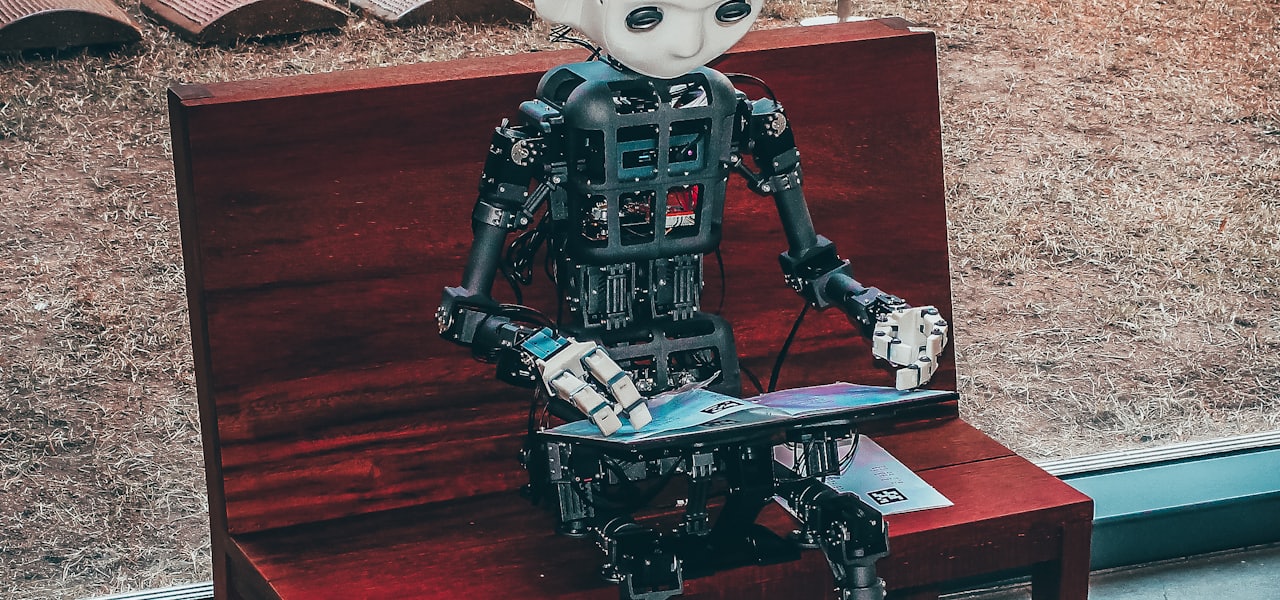
The Verbot (short for Verbal-Robot) was a chatbot program and artificial intelligence software development kit (SDK) designed for Windows and web platforms. == Early beginning == The origin of verbot traces back to Michael Mauldin's research during his time as a graduate student and post-doctoral fellow at Carnegie Mellon University. The creative foundation also stems from Peter Plantec's work in personality psychology and art direction. === Historic outline === In 1994, Michael Loren Mauldin, founder of Lycos, Inc., developed a prototype chatbot, Julia, which competed in the internationally known Turing test, for the coveted Loebner Prize. The Turing test matches computer scientist judges against machines to see if they can distinguish a computer from a real human. Julia was refined and developed, and in 1997, Dr. Mauldin and Peter Plantec, a clinical psychologist and animator, formed Virtual Personalities, Inc. (now Conversive, Inc.) in order to create a virtual human interface that would incorporate real-time animation as well as speech and natural language processing. The initial release, a stand-alone virtual person called Sylvie, was beta-tested to the public. This release was well received, and finally, after several versions, the production release (deemed version 3) of the Verbally Enhanced Software Robot, or Verbot, was deployed in fall 2000. The grandfather of all Verbots is Rog-O-Matic, which, although it could not talk, could and did explore a virtual world. Julia has been active on the internet in one form or another since 1989. A close cousin of Julia is Lycos, a robot that explores the World Wide Web and answers questions about it. Sylvie was the first Verbot with a face and a voice. Sylvie was the first Virtual Human with advanced, flexible interfacing capability. === Beginnings === The Virtual Personalities story goes back to 1978, where Mauldin was attending Rice University. Fascinated by the idea of ELIZA, he proceeded to write a program called "PET" for his 8 kilobyte Commodore PET Computer. PET included simple induction as a way to post new information, for example: Subject: I like my friend (later) Subject: I like food. PET: I have heard that food is your friend. Meanwhile, Plantec was separately designing a personality for "Entity", a theoretical virtual human that would interact comfortably with humans without pretending to be one. At that time the technology was not advanced enough to realize Entity. Mauldin got so involved with this that he majored in Computer Science and minored in Linguistics. === Rogue === In the late seventies and early eighties, a popular computer game at universities was Rogue, an implementation of Dungeons and Dragons where the player would descend 26 levels in a randomly created dungeon, fighting monsters, gathering treasure, and searching for the elusive "Amulet of Yendor". Mauldin was one of four grad students who devoted a large amount of time to building a program called "Rog-O-Matic" capable of retrieving the amulet and emerging victorious from the dungeon. === TinyMUD === In 1989, when James Aspnes at Carnegie Mellon created the first TinyMUD (a descendant of MUD and AberMUD), Mauldin was one of the first to create a computer player that would explore the text-based world of TinyMUD. But his first robot, Gloria, gradually accreted more and more linguistic ability, to the point that it could pass the "unsuspecting" Turing test. In this version of the test, the human has no reason to suspect that one of the other occupants of the room is controlled by a computer, and so is more polite and asks fewer probing questions. The second generation of Mauldin's TinyMUD robots was Julia, created on Jan. 8, 1990. Julia slowly developed into a more and more capable conversational agent, and assumed useful duties in the TinyMUD world, including tour guide, information assistant, note-taker, and message-relayer. She could even play the card game hearts along with the other human players. In 1991, Julia attended the first Loebner Prize contest in Boston, Massachusetts. Although she only finished third, she was ranked by one judge as more human than one of the human confederates, winning a coveted certificate of humanness in the world's first restricted Turing test. Julia continued to log in to various TinyMUD's and TinyMucks for the next seven years, and chatted with hundreds of people a month over the internet. === Lycos === Julia's job was to explore a virtual world consisting of pages of textual descriptions, with links between them, and to construct an internal map of that world and answer questions about it (including path information such as the shortest route from one room to another, and matching information, such as which rooms contained a certain kind of object or textual description). It was therefore only a very short cognitive leap from Julia to Lycos, another robotic agent that explores a virtual world made of hyperlinked pages of text, and which answers questions about those pages. Sylvie was born and her abilities were expanded greatly to include interfacing with computers and control systems via her serial ports. === Sylvie === Sylvie was the first intelligent animated virtual human. She was designed both as a conversation agent and as a virtual human interface that would form a bridge between the two. She became more popular as a conversation agent, but her designers believe she serves as a prototype for future virtual human interface design that will help us all cope with the increasing complexity of technology. As an aside, Plantec noticed that a large number of Sylvies have been sold in Southeast Asia. Upon investigation, he found out that students had discovered a "test" mode that would allow them to type in English sentences that Sylvie would pronounce in her somewhat stylized English. == Ownership == In 1997, Dr. Mauldin and Peter Plantec formed Virtual Personalities, Inc. to create Natural Language Processing solutions for companies. In 2001 Virtual Personalities, Inc. became Conversive, Inc. to reflect the focus on providing Customer Service and Marketing to the Enterprise Market. In late 2012 Avaya, Inc. acquired Conversive's assets including Verbots. == Verbot versions == The Verbot 4 version was created and released in 2004. In 2005 Version 4.1 of the Verbot Software was released with many feature enhancements and bug fixes, including built-in support for embedding C# code in outputs and conditionals. In early 2006 Conversive launched Verbots Online allowing Verbot 4 users to upload their knowledge and show off their bots to the world. In 2009 Version 5 was released, completely free and fully featured. In early 2012 the last version of Verbot, 5.0.1.2, was released to the general public with support for Windows 7. Later in 2012 Verbots Online completely shut down. == Verbots today == Verbots.com, its community of users, and its forums no longer exist, but the software and users can still be found. There has been no active development since the early 2012 release of Verbot 5.0.1.2.
Computer Dreams
Computer Dreams is a 1988 film created by Digital Vision Entertainment and released by MPI Home Video. Written, produced and directed by Geoffrey de Valois and hosted by Amanda Pays, it consists primarily of clips and behind-the-scenes work of early computer graphics animation. Notably included are Luxo Jr. and Red's Dream, the first two short films from Pixar. The film is an hour long and features an electronic score by Music Fantastic. It was revised and re-released on DVD as The History of Computer Animation, Volume 2. It won the Winner Gold Special Jury Award at the 1989 Houston International Film Festival, and the 1989 Golden Decade Award from the US Film & Video Festival. Music used includes: Gail Lennon - Desire, Gail Lennon - Like A Dream, Shandi Sinnamon - Making It,
Clustered file system
A clustered file system (CFS) is a file system which is shared by being simultaneously mounted on multiple servers. There are several approaches to clustering, most of which do not employ a clustered file system (only direct attached storage for each node). Clustered file systems can provide features like location-independent addressing and redundancy which improve reliability or reduce the complexity of the other parts of the cluster. Parallel file systems are a type of clustered file system that spread data across multiple storage nodes, usually for redundancy or performance. == Shared-disk file system == A shared-disk file system uses a storage area network (SAN) to allow multiple computers to gain direct disk access at the block level. Access control and translation from file-level operations that applications use to block-level operations used by the SAN must take place on the client node. The most common type of clustered file system, the shared-disk file system – by adding mechanisms for concurrency control – provides a consistent and serializable view of the file system, avoiding corruption and unintended data loss even when multiple clients try to access the same files at the same time. Shared-disk file-systems commonly employ some sort of fencing mechanism to prevent data corruption in case of node failures, because an unfenced device can cause data corruption if it loses communication with its sister nodes and tries to access the same information other nodes are accessing. The underlying storage area network may use any of a number of block-level protocols, including SCSI, iSCSI, HyperSCSI, ATA over Ethernet (AoE), Fibre Channel, network block device, and InfiniBand. There are different architectural approaches to a shared-disk filesystem. Some distribute file information across all the servers in a cluster (fully distributed). === Examples === == Distributed file systems == Distributed file systems do not share block level access to the same storage but use a network protocol. These are commonly known as network file systems, even though they are not the only file systems that use the network to send data. Distributed file systems can restrict access to the file system depending on access lists or capabilities on both the servers and the clients, depending on how the protocol is designed. The difference between a distributed file system and a distributed data store is that a distributed file system allows files to be accessed using the same interfaces and semantics as local files – for example, mounting/unmounting, listing directories, read/write at byte boundaries, system's native permission model. Distributed data stores, by contrast, require using a different API or library and have different semantics (most often those of a database). === Design goals === Distributed file systems may aim for "transparency" in a number of aspects. That is, they aim to be "invisible" to client programs, which "see" a system which is similar to a local file system. Behind the scenes, the distributed file system handles locating files, transporting data, and potentially providing other features listed below. Access transparency: clients are unaware that files are distributed and can access them in the same way as local files are accessed. Location transparency: a consistent namespace exists encompassing local as well as remote files. The name of a file does not give its location. Concurrency transparency: all clients have the same view of the state of the file system. This means that if one process is modifying a file, any other processes on the same system or remote systems that are accessing the files will see the modifications in a coherent manner. Failure transparency: the client and client programs should operate correctly after a server failure. Heterogeneity: file service should be provided across different hardware and operating system platforms. Scalability: the file system should work well in small environments (1 machine, a dozen machines) and also scale gracefully to bigger ones (hundreds through tens of thousands of systems). Replication transparency: Clients should not have to be aware of the file replication performed across multiple servers to support scalability. Migration transparency: files should be able to move between different servers without the client's knowledge. === History === The Incompatible Timesharing System used virtual devices for transparent inter-machine file system access in the 1960s. More file servers were developed in the 1970s. In 1976, Digital Equipment Corporation created the File Access Listener (FAL), an implementation of the Data Access Protocol as part of DECnet Phase II which became the first widely used network file system. In 1984, Sun Microsystems created the file system called "Network File System" (NFS) which became the first widely used Internet Protocol based network file system. Other notable network file systems are Andrew File System (AFS), Apple Filing Protocol (AFP), NetWare Core Protocol (NCP), and Server Message Block (SMB) which is also known as Common Internet File System (CIFS). In 1986, IBM announced client and server support for Distributed Data Management Architecture (DDM) for the System/36, System/38, and IBM mainframe computers running CICS. This was followed by the support for IBM Personal Computer, AS/400, IBM mainframe computers under the MVS and VSE operating systems, and FlexOS. DDM also became the foundation for Distributed Relational Database Architecture, also known as DRDA. There are many peer-to-peer network protocols for open-source distributed file systems for cloud or closed-source clustered file systems, e. g.: 9P, AFS, Coda, CIFS/SMB, DCE/DFS, WekaFS, Lustre, PanFS, Google File System, Mnet, Chord Project. === Examples === == Network-attached storage == Network-attached storage (NAS) provides both storage and a file system, like a shared disk file system on top of a storage area network (SAN). NAS typically uses file-based protocols (as opposed to block-based protocols a SAN would use) such as NFS (popular on UNIX systems), SMB/CIFS (Server Message Block/Common Internet File System) (used with MS Windows systems), AFP (used with Apple Macintosh computers), or NCP (used with OES and Novell NetWare). == Design considerations == === Avoiding single point of failure === The failure of disk hardware or a given storage node in a cluster can create a single point of failure that can result in data loss or unavailability. Fault tolerance and high availability can be provided through data replication of one sort or another, so that data remains intact and available despite the failure of any single piece of equipment. For examples, see the lists of distributed fault-tolerant file systems and distributed parallel fault-tolerant file systems. === Performance === A common performance measurement of a clustered file system is the amount of time needed to satisfy service requests. In conventional systems, this time consists of a disk-access time and a small amount of CPU-processing time. But in a clustered file system, a remote access has additional overhead due to the distributed structure. This includes the time to deliver the request to a server, the time to deliver the response to the client, and for each direction, a CPU overhead of running the communication protocol software. === Concurrency === Concurrency control becomes an issue when more than one person or client is accessing the same file or block and want to update it. Hence updates to the file from one client should not interfere with access and updates from other clients. This problem is more complex with file systems due to concurrent overlapping writes, where different writers write to overlapping regions of the file concurrently. This problem is usually handled by concurrency control or locking which may either be built into the file system or provided by an add-on protocol. == History == IBM mainframes in the 1970s could share physical disks and file systems if each machine had its own channel connection to the drives' control units. In the 1980s, Digital Equipment Corporation's TOPS-20 and OpenVMS clusters (VAX/ALPHA/IA64) included shared disk file systems.
IBM remote batch terminals
The IBM 2780 and the IBM 3780 are devices developed by IBM for performing remote job entry (RJE) and other batch functions over telephone lines; they communicate with the mainframe via Binary Synchronous Communications (BSC or Bisync) and replaced older terminals using synchronous transmit-receive (STR). In addition, IBM has developed workstation programs for the 1130, 360/20, 2922, System/360 other than 360/20, System/370 and System/3. == 2780 Data Transmission Terminal == The 2780 Data Transmission Terminal first shipped in 1967. It consists of: A line printer similar to the IBM 1443 that can print up to 240 lines per minute (lpm), or 300 lpm using an extremely restricted character set. A card reader/punch unit, similar to an IBM 1442, that can read up to 400 cards per minute (cpm) and can punch up to 355 cpm. A line buffer that stores data received or to be transmitted over the communications line. A binary synchronous adapter which controls the flow of data over the communications line. The 2780 is capable of local (offline) card to print operation. It comes in four models: Model 1: Can read punched cards and transmit the data to a remote host computer, and can receive and print data sent by the host. Model 2: Same as Model 1 but adds the ability to punch card data received from the host. Model 3: Can only print data received from the host, but not send data to it. Model 4: Can read and punch card data, but has no printing capabilities. The 2780 uses a dedicated communication line at speeds of 1200, 2000, 2400 or 4800 bits per second. It is a half duplex device, although full duplex lines can be used with some increase in throughput. It can communicate in Transcode (a 6-bit code), 8-bit EBCDIC, or 7-bit ASCII. == 2770 Data Communication System == The 2770, announced in 1969, "was said to surpass all other IBM terminals in the variety of available input-output devices." The 2770 was developed by the IBM General Products Division (GPD) in Rochester, MN. It comes standard with a desktop terminal with keyboard. The printer and other devices (any two in any combination) can be attached to the 2772 Multi-Purpose Control unit. Possible devices include: 50 Magnetic Data Inscriber 545 Card Punch Model 3 (non-printing) or Model 4 (printing) 1017 Paper Tape Reader 1018 Paper Tape Punch 1053 Printer Model 1 1255 Magnetic Character Reader Models 1, 2 or 3 2203 Printer Model A1 or A2 2213 Printer Model 1 or 2 2265 Display Station Model 2 2502 Card Reader Model A1 or A2 5496 Data Recorder == 3780 Data Communications Terminal == In May 1972, IBM announced the IBM 3780, an enhanced version of the 2780. The 3780 was developed by IBM's Data Processing Division (DPD). There is one model, with an optional card punch. The 3780 drops Transcode support and incorporates several performance enhancements. It supports compression of blank fields in data using run-length encoding. It provides the ability to interleave data between devices, introduces double buffering, and adds support for the Wait-before-transmit ACKnowledgement (WACK) and Temporary Text Delay (TTD) Binary Synchronous control characters. The integrated punched card unit can read cards at 600 cards per minute. The integrated printer is rated at 300, 350 or 425 lines per minute based on characters set (63, 52 or 39 characters). The 3781 Card Punch is an optional feature. It punches 160 columns per second, or 91 cards per minute if all 80 columns are punched. The IBM 2780 and 3780 were later emulated on various types of equipment, including eventually the personal computer. A notable early emulation was the DN60, by Digital Equipment Corporation in the late 1970s. == 3770 Data Communications System == In 1974 IBM Data Processing Division (DPD) offered a successor to the 3780, called the 3770 Data Communications System, supporting SDLC, BSC, BSC Multi-leaving and SNA, depending on the configuration. The 3770 is a family of desk console style terminals that offers a variety of keyboard and printer combinations as well as I/O equipment attachment and communications features. The terminals come built into a desk and include the following models: 3771 Communication Terminal (optional card reader, optional card punch, wire matrix printer) Models 1 (40 cps printer), 2 (80 cps printer), and 3 (120 cps printer). 3773 Communication Terminal (diskette, wire matrix printer) Models 1 (40 cps printer), 2 (80 cps printer), and 3 (120 cps printer). Each model has a P version which adds some programming features. 3774 Communication Terminal (optional card reader, optional card punch, optional belt printer, wire matrix printer) Models 1 (80 cps printer), and 2 (120 cps printer). Each model has a P version which adds some programming features, a 480-character display and a non-removable diskette. 3775 Communication Terminal (optional card reader, optional card punch, optional diskette, belt printer) Model 1 (120 lpm printer). The model P1 adds some programming features, a 480-character display and a non-removable diskette. 3776 Communication Terminal (optional card reader, optional card punch, optional diskette, belt printer) Models 1 (300 lpm printer) and 2 (400 lpm printer). Models 3 and 4 are similar to models 1 and 2. 3777 Communication Terminal (optional card reader, optional diskette, train printer) Model 1 (up to 1000 lpm printer depending on character set). Model 2 adds an optional card punch, model 3 adds an optional magnetic tape drive and model 4 replaces the train printer with a slower model called the IBM 3262. The model 4 also allows a second, optional, 3262. The following I/O devices can be attached to a 3770 terminal: IBM 2502 Card Reader: Models A1 (up to 150 card per minute), A2 (up to 300 cards per minute) or A3 (up to 400 cards per minute) IBM 3203 Printer Model 3: 1000 LPM using 48 character set IBM 3501 Card Reader: Up to 50 cards per minute desktop unit IBM 3521 Card Punch: Up to 50 cards per minute IBM 3782 Card Attachment unit, which allows the 2502 or 3521 to be attached to any terminal except the 3777 IBM 3784 Line Printer, can be attached to a 3774 as a second printer. Up to 155 LPM with 48 characters set print belt. == Workstation programs == IBM distributes workstation programs with systems software including OS/360 Attached Support Processor (ASP) Houston Automatic Spooling Priority (HASP and HASP II) Operating System/Virtual Storage 1 (OS/VS1) Operating System/Virtual Storage 2 (OS/VS2 MVS) Release 2 through 3.8 MVS versions from MVS/SP Version 1 through z/OS Priority Output Writers, Execution processors and input Readers (POWER) Remote Spooling Communications Subsystem (RSCS) Except for the RJE workstation programs in OS/360, these programs use a variation of BSC known as Multi-leaving. In addition, IBM provides separately ordered workstation programs using BSC. Systems Network Architecture (SNA) and TCP/IP. Workstation programs are available from IBM and third-party vendors to support all of these protocols: 2770/3770 2780/3780 Multileaving Network Job Entry (NJE) OS/360 RJE SNA TCP/IP
Pinoy baiting
Pinoy baiting is a phrase that has been used to refer to acts by non-Filipino individuals, usually celebrities or YouTubers, of posting content online purportedly with the intention of getting the attention of Filipinos, by being surprised about the Philippines or its people. Pinoy baiters are defined as giving superficial and allegedly insincere praises and similar reactions that give recognition to the Philippines or its people. Subsequent responses by Filipinos to what have been referred to as acts of Pinoy baiting have been criticized as a form of cultural cringe. This criticism would subsequently give the advice that Filipinos should not constantly require validation from non-Filipinos about themselves or their country. == Pinoy baiting mediums == === Reaction videos === On social media such as YouTube, channels with specific focus on showing their reaction towards and opinions about certain videos or topics are called reaction channels. Reaction videos are very popular and require minimal effort to create, and thus made it easy for alleged Pinoy baiting to thrive within this video-making genre. === Travel vlogs === Vlogging, short for video blogging, grew in popularity in the 2020s. Most of the popular alleged Pinoy-baiting channels tend to be vlog channels, normally following the same script under such titles as "The Philippines changed us/me", "First impression of the Philippines", "Is this really Manila?" and "Filipinos are such Kind/Good People!", and made while travelling to touristy areas such as Boracay or Bonifacio Global City and taste-testing the fast food chain Jollibee, among others. == Criticism of the phrase == Philippines-based Korean vlogger Jessica Lee had been accused by some YouTube viewers of engaging in Pinoy baiting. In a response vlog, Lee acknowledged that there may be individuals engaging in this "business strategy" of gaining views and subscribers from one of the largest communities online. However, she questioned the objectivity of some use of the phrase, citing any vlogging subject as fair game for a negative impression of being a "baiting" tool for the vlogger treating of that subject. She also invoked vloggers' freedom to choose whatever subject they want to talk about in a deep or shallow manner, while enjoining citizens to exercise their free-market right to unfollow vloggers they hate and follow those vloggers that "make them happy". She also gave her critics an explanation why she ended up vlogging about Philippine and Filipino subjects.
Spike-and-slab regression
Spike-and-slab regression is a type of Bayesian linear regression in which a particular hierarchical prior distribution for the regression coefficients is chosen such that only a subset of the possible regressors is retained. The technique is particularly useful when the number of possible predictors is larger than the number of observations. The idea of the spike-and-slab model was originally proposed by Mitchell & Beauchamp (1988). The approach was further significantly developed by Madigan & Raftery (1994) and George & McCulloch (1997). A recent and important contribution to this literature is Ishwaran & Rao (2005). == Model description == Suppose we have P possible predictors in some model. Vector γ has a length equal to P and consists of zeros and ones. This vector indicates whether a particular variable is included in the regression or not. If no specific prior information on initial inclusion probabilities of particular variables is available, a Bernoulli prior distribution is a common default choice. Conditional on a predictor being in the regression, we identify a prior distribution for the model coefficient, which corresponds to that variable (β). A common choice on that step is to use a normal prior with a mean equal to zero and a large variance calculated based on ( X T X ) − 1 {\displaystyle (X^{T}X)^{-1}} (where X {\displaystyle X} is a design matrix of explanatory variables of the model). A draw of γ from its prior distribution is a list of the variables included in the regression. Conditional on this set of selected variables, we take a draw from the prior distribution of the regression coefficients (if γi = 1 then βi ≠ 0 and if γi = 0 then βi = 0). βγ denotes the subset of β for which γi = 1. In the next step, we calculate a posterior probability for both inclusion and coefficients by applying a standard statistical procedure. All steps of the described algorithm are repeated thousands of times using the Markov chain Monte Carlo (MCMC) technique. As a result, we obtain a posterior distribution of γ (variable inclusion in the model), β (regression coefficient values) and the corresponding prediction of y. The model got its name (spike-and-slab) due to the shape of the two prior distributions. The "spike" is the probability of a particular coefficient in the model to be zero. The "slab" is the prior distribution for the regression coefficient values. An advantage of Bayesian variable selection techniques is that they are able to make use of prior knowledge about the model. In the absence of such knowledge, some reasonable default values can be used; to quote Scott and Varian (2013): "For the analyst who prefers simplicity at the cost of some reasonable assumptions, useful prior information can be reduced to an expected model size, an expected R2, and a sample size ν determining the weight given to the guess at R2." Some researchers suggest the following default values: R2 = 0.5, ν = 0.01, and π = 0.5 (parameter of a prior Bernoulli distribution).
Sex differences in social media use
Men and women use social media in different ways and with different frequencies. In general, several researchers have found that women tend to use social network services (SNSs) more than men and primiarly to socialize. == Differences == === Predilection for usage === Many studies have found that women are more likely to use either specific SNSs such as Facebook or MySpace or SNSs in general. In 2015, 73% of online men and 80% of online women used social networking sites. The gap in gender differences has become less apparent in LinkedIn. In 2015 about 26 percent of online men and 25% of online women used the business-and employee-oriented networking site. Researchers who have examined the gender of users of multiple SNSs have found contradictory results. Hargittai's groundbreaking 2007 study examining race, gender, and other differences between undergraduate college student users of SNSs found that women were not only more likely to have used SNSes than men but that they were also more likely to have used many different services, including Facebook, MySpace, and Friendster; these differences persisted in several models and analyses. Although she only surveyed students at one institution – the University of Illinois at Chicago – Hargittai selected that institution intentionally as "an ideal location for studies of how different kinds of people use online sites and services." In contrast, data collected by the Pew Internet & American Life Project found that men were more likely to have multiple SNS profiles. Although the sample sizes of the two surveys are comparable – 1,650 Internet users in the Pew survey compared with 1,060 in Hargittai's survey – the data from the Pew survey are newer and arguably more representative of the entire adult United States population. Pinterest, Facebook, and Instagram attract more females. Picture sharing sites overall are very popular among women. Pinterest alone attracts three times as many female users than male. However, use of Pinterest by men has increased from 5% in 2012. Facebook attracts about 77% of women online. Instagram is also more likely to attract women. Men are more likely to participate in online forums like Reddit, Digg or Slashdot. One in five men claim to be a part of an online forum. === Uses === In general, women seem to use SNSs more to explicitly foster social connections. A study conducted by Pew research centers found that women were more avid users of social media. In November 2010, the gap between men and women was as high as 15%. Female participants in a multi-stage study conducted in 2007 to discover the motivations of Facebook users scored higher on scales for social connection and posting of photographs. Studies have also been conducted on the differences between females and males with regards to blogging. The Pew Research Center found that younger females are more likely to blog than males their own age, even males that are older than them. Similarly, in a study of blogs maintained in MySpace, women were found to be more likely to not only write blogs but also write about family, romantic relationships, friendships, and health in those blogs. A study of Swedish SNS users found that women were more likely to have expressions of friendship, specifically in the areas of (a) publishing photos of their friends, (b) specifically naming their best friends, and (c) writing poems to and about their friends. Women were also more likely to have expressions related to family relationships and romantic relationships. One of the key findings of this research is that those men who do have expressions of romantic relationships in their profile had expressions just as strong as the women. However, the researcher speculated that this may be in part due to a desire to publicly express heterosexual behaviors and mannerisms instead of merely expressing romantic feelings. A large-scale study of gender differences in MySpace found that both men and women tended to have a majority of female Friends, and both men and women tended to have a majority of female "Top" Friends in the site. A later study found women to author disproportionately many (public) comments in MySpace, but an investigation into the role of emotion in public MySpace comments found that women both give and receive stronger positive emotion. It was hypothesised that women are simply more effective at using social networking sites because they are better able to harness positive emotion. A study focused on the influence of gender and personality on individuals' use of online social networking websites such as Facebook, reported that men use social networking sites with the intention of forming new relationships, whereas, women use them more for relationship maintenance. In addition to this, women are more likely to use Facebook or MySpace to compare themselves to others and also to search for information. Men, however, are more likely to look at other people's profiles with in the intention to find friends. Women were less successful at actually finding new friends, but more successful at "maintaining existing relationships, making new relationships, using for academic purposes and following specific agenda". Similarly, men also self-reported this motivation "while women reported using them more for relationship maintenance". === Personality === OCEAN personality traits are known to systematically vary between human males and females. In one study, the same women were more extraverted and agreeable, such as less neurotic while on social media than offline. Other studies associated neuroticism with female use of social media. === Privacy === Privacy has been the primary topic of many studies of SNS users, and many of these studies have found differences between male and female SNS users, although some studies have found results contradictory to those found in other studies. Some researchers have found that women are more protective of their personal information and more likely to have private profiles. Other researchers have found that women are less likely to post some types of information. Acquisti and Gross found that women in their sample were less likely to reveal their sexual orientation, personal address, or cell phone number. This is similar to Pew Internet & American Life research of children users of SNSs that found that boys and girls presented different views of privacy and behaviors, with girls being more concerned about and restrictive of information such as city, town, last name, and cell phone number that could be used to locate them. At least one group of researchers has found that women are less likely to share information that "identifies them directly – last name, cell phone number, and address or home phone number," linking that resistance to women's greater concerns about "cyberstalking", "cyberbullying", and security problems. Despite these concerns about privacy, researchers have found that women are more likely to maintain up-to-date photos of themselves. Further, Kolek and Saunders found in their sample of college student Facebook users that women were more likely to not only post a photograph of themselves in their profile but that they were more likely to have a publicly viewable Facebook account (a contradictory finding compared to many other studies), post photos, and post photo albums. Women were more likely to have: (a) a publicly viewable Facebook account, (b) more photo albums, (c) more photos, (d) a photo of themselves as their profile picture, (e) positive references to alcohol, partying, or drugs, and (f) more positive references to or about the institution or institution-related activities. In general, women were more likely to disclose information about themselves in their Facebook profile, with the primary exception of sharing their telephone number. Similarly, female respondents to Strano's study were more likely to keep their profile photo recent and choose a photo that made them appear attractive, happy, and fun-loving. Citing several examples, Strano opined that there may also be a difference in how men and women Facebook users display and interpret profile photos depicting relationships. Privacy has also been a concern for the SnapChat app, which allows you to send messages either text or photo or video which then disappear. One study has shown that security is not a major concern for the majority of users and that most do not use Snapchat to send sensitive content (although up to 25% may do so experimentally). As part of their research almost no statistically significant gender differences were found. === Cyberbullying === Past research carried out to investigate if there are any gender differences in cyber-bullying has found that boys commit more cyber verbal bullying, cyber forgery and more violence based on hidden identity or presenting themselves as other person. === Mansplaining === A 2021 article found that mansplaining could be seen more prominent online rather than offl